Most recovery advice is a fixed list. Cold plunge on Monday, mobility on Wednesday, a rest day on Sunday. It looks disciplined. The problem is that your body doesn't run on a calendar — it runs on load, sleep, stress, and a dozen inputs that change day to day. A rest day scheduled for Sunday is useless if the day you actually needed it was Thursday.
The fix isn't a better fixed routine. It's a routine that reads this morning's numbers and picks today's plan accordingly. That's what a data-driven recovery routine is: not more tips, but a decision tree that turns your wearable data into a single call — push, maintain, or back off — before you've had coffee.
This post gives you that decision tree, the science behind why adaptive beats fixed, and the exact metrics to build it around.
Why adaptive beats a fixed schedule (the actual evidence)
This isn't a wellness-blog assertion. A 2021 systematic review and meta-analysis compared HRV-guided training — where the day's session adapts to your morning HRV reading — against predefined, fixed-schedule training. The finding: adaptive training was superior for maintaining and improving vagal-mediated HRV, and came with less likelihood of negative responses (overtraining, non-functional overreaching) than a fixed plan (Manresa-Rocamora et al., 2021[1]).
The mechanism is intuitive once you see it. A fixed plan applies the same load regardless of your state. On a day when your nervous system is already depleted, that load digs the hole deeper. An adaptive plan pulls back exactly on those days and lets you push on the days you've genuinely recovered — so you accumulate the work that helps and skip the work that harms.
The same logic applies to recovery, not just training. A recovery routine that adapts to your data protects you from the two failure modes of fixed routines: doing too much on a depleted day, and wasting a recovered day on unnecessary rest.
The three metrics that decide your day
You don't need a lab. You need three signals your wearable already tracks, read as a cluster rather than individually.
HRV
Heart rate variability is the single best daily readout of autonomic recovery. What matters is not today's absolute number but where it sits relative to your personal 7-day rolling baseline. A reading well below baseline means your nervous system hasn't recovered.
Resting heart rate
An elevated overnight or morning RHR — roughly 5+ bpm above your baseline — is a classic sign of incomplete recovery, illness onset, or accumulated stress.
Sleep
Not just the score, but whether duration and depth actually matched your need. A high "score" on four hours of sleep is still four hours of sleep.
Read together, these three tell you far more than any one alone. A low HRV with elevated RHR and short sleep is an unambiguous red day. A low HRV with everything else normal might just be daily noise. If you're chasing a red recovery score that doesn't match how you feel, the cluster is usually where the answer is.
The decision tree: green, amber, red
Here's the routine. Each morning, check your three signals against baseline, then follow the branch.
Everything at or above baseline
Your HRV is at or above your 7-day baseline, RHR is normal, sleep was adequate. Recovery focus: light. You're recovered — this is a day to use, not protect.
- Do: train hard if it's a training day, or bank an active-recovery session that still adds fitness (zone 2, mobility with intent).
- Don't: waste it on a full rest day out of habit. Green days are when adaptation happens.
One signal is off
One metric is below baseline (say, HRV dipped but RHR and sleep are fine), or all three are marginally soft. Recovery focus: moderate. Something is asking for attention, but it's not a shutdown.
- Do: reduce intensity, keep volume light-to-moderate, add one active recovery input (10–15 min breathwork, a walk, mobility). Re-check tomorrow.
- Don't: push a hard session hoping the number is wrong. On amber, the cost of pushing outweighs the benefit.
Two or more signals are off
HRV well below baseline and elevated RHR, or poor sleep stacked on a low HRV. Recovery focus: maximal. Your body is telling you it's under-recovered, stressed, or fighting something.
- Do: true rest or the gentlest possible movement. Prioritise sleep tonight, hydration, and stress reduction. This is the day the fixed-schedule crowd trains through — and pays for later.
- Don't: treat the red flag as a challenge. Red days handled well are what let you have more green days.
Reading the signal vs. the noise
The most common mistake with adaptive routines is overreacting to a single day. HRV is naturally noisy — one low reading after a late meal or a glass of wine isn't a red day.
Two rules keep you honest:
- Trust the trend, not the point. Compare today against a 7-day rolling average, not yesterday. A single dip inside your normal range is noise; three days trending down is signal.
- Add the subjective layer. How you actually feel is data too. If every metric says green but you feel wrecked, respect that — and vice versa. The most reliable call blends the numbers with the honest gut check.
There's also the dip-then-rebound pattern worth knowing: after a genuinely hard session or a new training stimulus, a short-term HRV drop followed by a rebound above baseline is a sign of positive adaptation, not a problem. Panicking at the dip and backing off too early can cost you the adaptation.
The catch: doing this manually is the hard part
The logic above is simple. Executing it every single morning — pulling HRV, checking it against a rolling baseline, cross-referencing RHR and sleep, factoring how you feel, and landing on one clear call — is the part that quietly falls apart by week two. Most people either skip the check or stare at three dashboards and guess. Getting a unified view of your daily data is harder than it sounds, because the metrics you need rarely live in the same app.
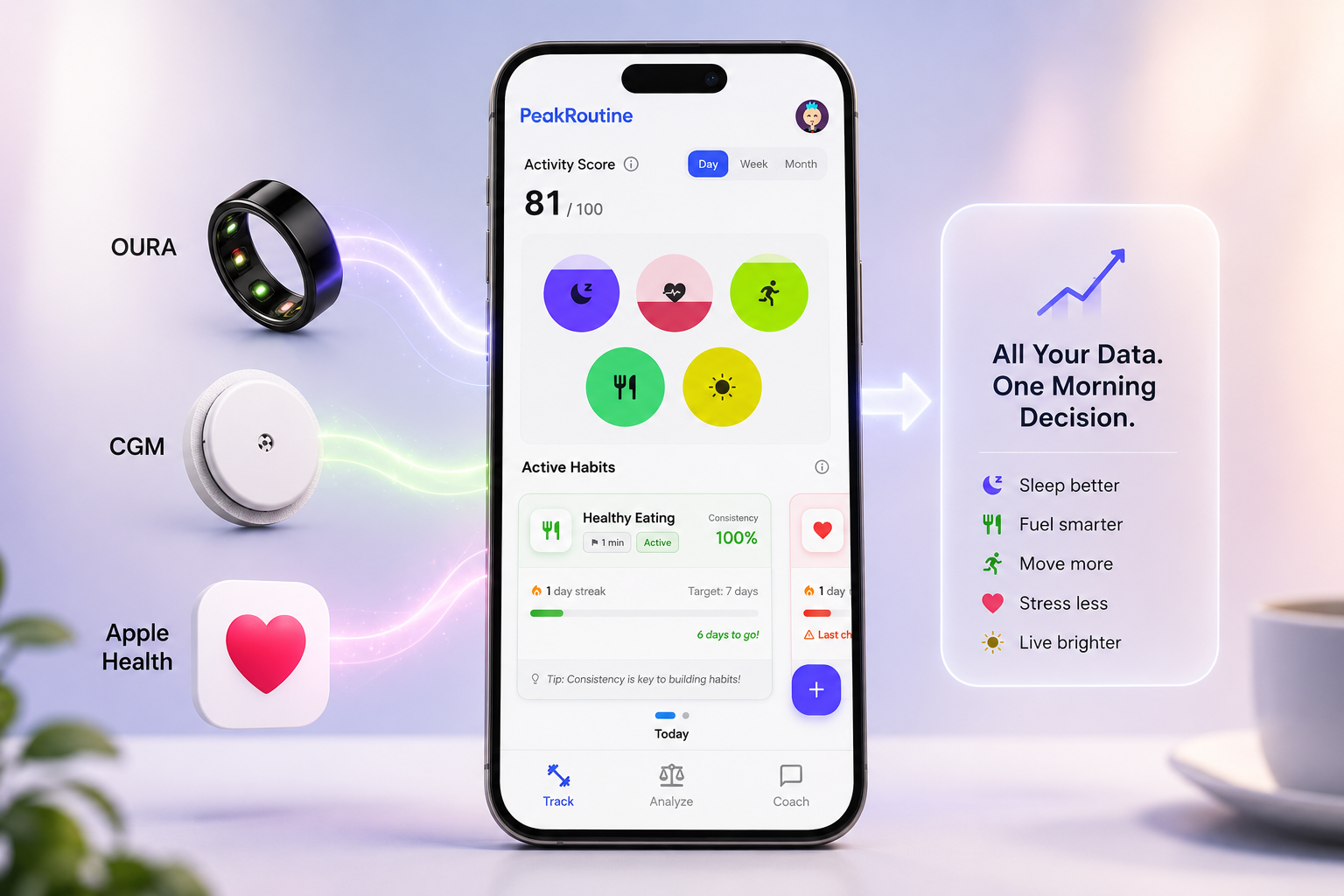
This is the gap PeakRoutine is built to close. Instead of you manually reconciling HRV, RHR, sleep, and stress each morning, it reads them together against your personal baseline and returns the one thing this routine actually needs: today's call, in plain language, with the why attached — so the green/amber/red decision is made for you before you're even out of bed. That's the difference between knowing adaptive recovery is better and actually running it every day. And because a call you can't inspect is just another black box, you can see exactly how our own score is built — every pillar, weight, and rule.
One glance, one decision — the three metrics reconciled for you.
How to start this week
- Establish your baselines first. Spend 7–10 days just recording HRV, RHR, and sleep without changing anything. You can't run an adaptive routine without knowing what "normal" is for you.
- Pick your three metrics and your thresholds. Baseline HRV, RHR +5 bpm, and adequate sleep are reasonable starting lines — adjust as you learn your own patterns.
- Run the tree every morning for two weeks. Make the green/amber/red call before deciding your day.
- Review weekly. Did red days you respected lead to more green days after? That feedback loop is what turns this from a gimmick into a habit that compounds.
Once the morning call is reliable, the natural next step is to attach a habit to each morning metric, so the decision doesn't just get made — it gets acted on.
FAQ
How is a data-driven recovery routine different from just following a recovery plan?
A recovery plan is fixed — the same actions on the same days regardless of your state. A data-driven routine adapts each morning: your current HRV, resting heart rate, and sleep decide whether today calls for pushing, maintaining, or backing off. Research on HRV-guided approaches suggests adapting to daily readiness maintains autonomic recovery better and reduces the risk of overtraining compared to fixed schedules.
Which metric matters most for deciding my day?
No single one — they're most reliable read as a cluster against your personal baseline. HRV is the best individual daily readout of autonomic recovery, but a low HRV combined with elevated resting heart rate and poor sleep is a far stronger signal than any one metric alone. Always compare against a 7-day rolling average, not yesterday's number.
What if my numbers say I'm recovered but I feel terrible (or vice versa)?
Respect the mismatch — how you feel is legitimate data. Wearable metrics are relative to your baseline and can miss things like acute illness or emotional stress. The most reliable daily call blends the numbers with an honest subjective check rather than treating either as absolute.
References
- Manresa-Rocamora A, Sarabia JM, Javaloyes A, Flatt AA, Moya-Ramón M. Heart rate variability-guided training for enhancing cardiac-vagal modulation, aerobic fitness, and endurance performance: a methodological systematic review with meta-analysis. International Journal of Environmental Research and Public Health. 2021;18(19):10299. doi:10.3390/ijerph181910299. https://pubmed.ncbi.nlm.nih.gov/34639599/