Most wellness apps hand you a single morning number and expect you to trust it. How it's calculated, what's weighted heaviest, what happens on a day you forget to log lunch — all of it sits behind a wall you're not meant to see past. And the moment that number disagrees with your body, you have nothing to check it against, which is exactly why a score that contradicts how you actually feel is so frustrating: an opaque score is an interpretation, not a measurement.
So here's ours, in full. This is exactly what feeds your Peak Score — the 0–100 figure PeakRoutine shows you first thing each morning — how much each piece is worth, and the rules that govern the days you barely log anything. Nothing hidden.
The three pillars: unevenly weighted, on purpose
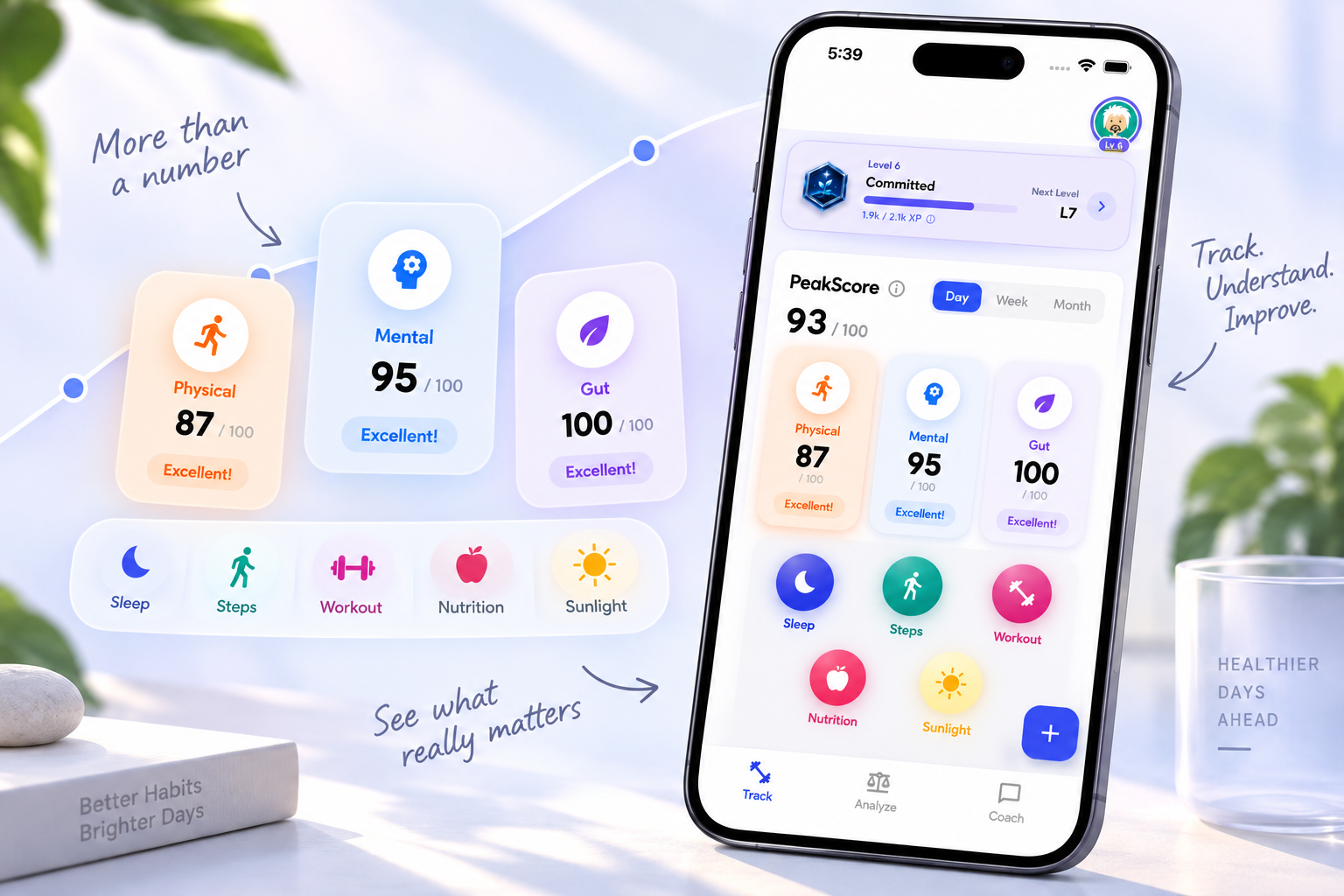
Peak Score summarizes your day across three areas, and they don't carry equal weight.
Physical carries the most because it has the most inputs and the deepest research base behind it. Gut sits entirely on what you choose to log — no sensor can eat a meal for you.
Ten raw inputs feed those three pillars, but only eight distinct things are actually being measured. Sleep and daylight each do double duty — counted once toward Physical and again toward Mental — because a bad night and a sunless afternoon genuinely cost you on both fronts. HRV is the same reading interpreted twice: once as a fitness signal in Physical, once as a stress signal in Mental.
The counterintuitive part: nutrition is your biggest lever, not sleep
Pillar weights only tell part of the story, because sleep and daylight are split across two pillars. Add up each input's true share of the final number and a different picture appears.
Each input's true share of the final 0–100, after the double-counted metrics are resolved.
Nutrition, not sleep, is the single biggest input in your score. And the passive/active split matters.
The score rewards showing up as much as it rewards the underlying physiology.
How each pillar is actually scored
Physical 40% of Peak Score
-
30%Sleep. Mostly duration, measured against a target that shifts with age (nine hours under 65, eight after). When your device reports sleep stages, a quality component blends in deep-sleep share, REM share, and efficiency — landing at roughly 70% duration, 30% quality.
-
20%Steps. A straight ratio against a personalized daily target (9,000 by default, adjusted for age).
-
20%Workout minutes. Scored on the week, not the day, against the WHO's 150–300 minutes of moderate activity. Hit 150 for the week and you're already at 80/100; 300 caps it at 100.
-
20%Heart-rate variability. Measured against your own 14-day weighted rolling baseline — never a population norm, because a "good" HRV is different for everyone. New users get a neutral cold-start score of 60 until seven days of data build a real baseline.
-
10%Daylight. Raw outdoor-light minutes. Five minutes earns partial credit; thirty minutes is full marks.
Mental 30% of Peak Score
-
30%Stress / HRV. The same HRV-against-baseline reading as Physical, interpreted here as a recovery signal instead of a fitness one.
-
25%Mood check-in. Scored on whether you logged a mood, not what you logged. A rough day recorded honestly scores exactly the same as a great one.
-
20%Sleep. The same sleep score as Physical, counted again — poor sleep is a mental cost as much as a physical one.
-
15%Daylight. The same daylight reading, on the strength of circadian-light research linking sunlight to mood regulation.
-
10%Journaling. Like mood, this rewards the act of writing, not the sentiment of what's written.
The design choice worth naming: mood and journaling are graded as logged today or not — nothing more. A hard day, honestly recorded, never lowers your score. It isn't judged; it's just checked off. That's deliberate, so the score never punishes you for being honest about a bad day.
Gut 30% of Peak Score
-
70%Nutrition. Three things inside one number: meal-logging consistency (10%), macronutrient balance (35%), and calorie-target adherence (55%). Your calorie target isn't a generic 2,000 — it's derived from your age, sex, height, and weight using the Mifflin–St Jeor equation (the formula clinicians use to estimate resting metabolic rate), then nudged by how active your day looks. The adherence piece only switches on once all three meals are logged, and it's floored at 70 — a rough eating day can dent that slice but can't wreck it.
-
30%Hydration. A plain ratio of what you drank against your daily water goal.
What a blank day actually costs you
This is the part most apps never explain, and it's where the design gets careful.
At the metric level, nothing is forgiven
An unrecorded reading — sensor or self-logged — scores a strict zero and keeps its full weight. Skip a walk and steps costs you exactly what it looks like it costs.
Forgiveness happens one level up
If an entire pillar has zero data for the day, its whole weight is handed to the other two rather than dragging your headline number down for a part of your life you simply didn't touch.
There's a cap on that handoff — 2× a pillar's own weight — so no single pillar can carry the whole score alone: Physical by itself tops out at 80, Gut by itself at 60.
One sharp edge worth knowing
Forgiveness switches off the moment you log one thing in a pillar. Track a single glass of water and Gut is graded strictly from zero again — which means a token log can occasionally score worse than logging nothing at all.
It's not a bug; it's the honest cost of the rule. An empty pillar is forgiven; a half-tried one is graded.
What changed in August 2026
Until a policy fix that month, a pillar with zero data was scored zero and kept its full weight — so a day with no food or water logged capped your Peak Score at 70 no matter how well you slept or trained. A hard ceiling like that is more discouraging than a bad score, so it was replaced with the handoff rule above.
The one true exception: hardware you don't own
If your device has never once reported HRV, or has no ambient-light sensor, that specific metric is dropped from its pillar's math entirely — not scored zero, not guessed at. The pillar simply renormalizes over what your hardware can actually measure.
Without this rule, a fitness band with no light sensor would cap its owner below 100 forever, for owning the wrong watch rather than skipping a habit.
Reading the number
| Range | Meaning |
|---|---|
| 90–100 | Excellent |
| 70–89 | Good |
| 50–69 | Average |
| 30–49 | Below average |
| 0–29 | Poor |
There's also a number behind the number, computed every day but not yet shown in the app: coverage — what share of your day was actually backed by real data, independent of how well the day went. A high Peak Score doesn't always mean a well-measured one; an untouched pillar can hand away its weight and still let a day read near 100 on thin coverage. Coverage is the only field that can tell a "quiet day" apart from a "bad day."
What Peak Score isn't
Peak Score is a wellness indicator, not a diagnostic — it doesn't screen for disease. HRV and sleep-stage readings from consumer wearables are estimates, not clinical-grade measurements, and the score is only as accurate as the data reaching it: limited Health permissions mean a fuzzier picture. None of this replaces a conversation with a qualified healthcare professional.
Every target above is pinned to published guidance — sleep duration to the CDC and the American Academy of Sleep Medicine, activity to the WHO and the U.S. Physical Activity Guidelines, calories to the Mifflin–St Jeor equation and USDA Dietary Guidelines, HRV interpretation to Harvard Health, and daylight to circadian-rhythm research from the NIH. The full source list lives in the in-app methodology page.
Why we publish this
A score you can't inspect asks for trust it hasn't earned. Publishing every weight does two things: it lets you act on the number — if nutrition is your biggest lever, that's where a bad day is costing you most — and it holds us accountable to a formula you can check.
That's the whole thesis of PeakRoutine in one number: tracking is solved; turning it into your next move is the hard part, and you can't make a move you don't understand. The daily version of that move is letting this morning's numbers pick today's plan; the monthly version is a 30-day plan to raise the HRV baseline feeding two of the ten inputs above.
You can revisit this breakdown any time from the dashboard: tap Peak Score → ⓘ → View full methodology.
FAQ
What is Peak Score?
Peak Score is a single 0–100 number PeakRoutine shows each morning, summarizing your day across three weighted pillars: Physical (40%), Mental (30%), and Gut (30%). It's built from ten inputs — roughly 60% measured automatically by your phone or wearable and 40% self-logged — and every weight is published rather than hidden.
What has the biggest impact on my Peak Score?
Nutrition. Measured by its true share of the final number, nutrition is the single largest input at 21%, ahead of sleep at 18%. This surprises most people, who assume sleep or HRV dominates. Because nutrition and hydration are fully self-logged, the days you don't log meals are also the days your score has the least real data behind it.
What happens to my Peak Score on days I don't log anything?
At the individual-metric level, an unrecorded input scores zero. But if an entire pillar has no data at all, its weight is handed to the other two pillars (capped at 2× that pillar's weight) rather than tanking your score. One quirk: logging a single item in a pillar switches that forgiveness off and grades the pillar strictly, so a token log can sometimes score lower than logging nothing.
Is Peak Score a medical measurement?
No. It's a wellness indicator for general informational purposes, not a diagnostic tool, and consumer-wearable HRV and sleep readings are estimates rather than clinical-grade measurements. It doesn't screen for or diagnose any condition and isn't a substitute for professional medical advice.