By the PeakRoutine Team · Reviewed for accuracy against peer-reviewed research
The Math That Doesn't Add Up
Most of us learned to think about sleep in a straight line: sleep more, feel better; sleep less, feel worse. But if you've woken after a full eight hours, reached for coffee by 10am, and faded by 2pm, you already know it isn't that simple.
The answer usually has less to do with how long you slept and more to do with how effectively your body recovered during those hours — and that's shaped by far more than time on the pillow.
Sleep and Recovery Are Not the Same Thing
We use "sleep" and "recovery" interchangeably, but they're different.
Sleep is something you do. Recovery is something your body achieves.
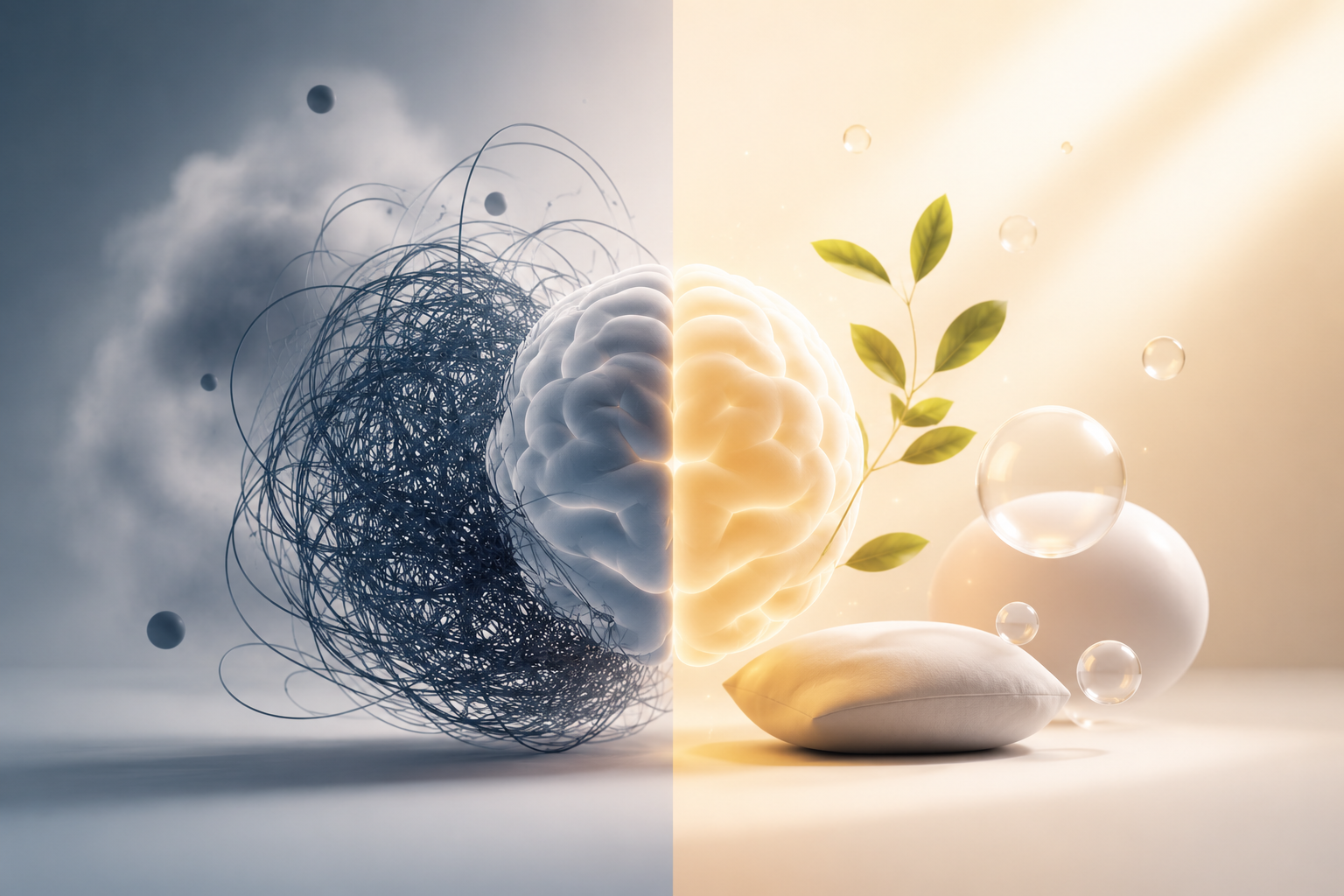
Eight hours in bed doesn't guarantee eight hours of good recovery. While you sleep, your body runs a stack of essential processes — hormonal regulation, tissue repair, memory consolidation, immune activity, and winding down the stress response. How well that work gets done is what determines whether you wake up restored or flat.
And it depends on quality and continuity, not just duration. A review of the health consequences of sleep disruption found that fragmented or poor-quality sleep — not only short sleep — drives increased stress responsivity, mood disturbance, and cognitive and performance deficits (Medic et al., 2017[1]). It's exactly why two people can both sleep eight hours and wake up feeling completely different.
The Problem Often Starts Before Bed
When we wake up tired, we blame sleep. But sleep is usually where the problem becomes visible, not where it begins. Think back over your last few days — more stress than usual, later meals, a day spent sitting indoors, scrolling right up to lights-out. Each of those quietly shapes how well you recover overnight.
Stress is a clear example: it doesn't switch off when you fall asleep. Chronic stress keeps your "alert" nervous system engaged, and studies consistently link it to reduced parasympathetic (rest-and-repair) activity — the same state associated with poorer overnight recovery (Kim et al., 2018[2]). You can be technically asleep for eight hours while your body never fully downshifts.
Your Energy Is a Network, Not a Number
Here's the shift that changes everything. Picture your body as a connected system rather than separate parts:
Poor sleep affects recovery → recovery affects energy → energy affects motivation → motivation affects movement → movement affects sleep.
Suddenly a "sleep problem" looks like part of a much larger loop. This is why so many people stay stuck: they track isolated symptoms instead of the relationships between them. They notice the afternoon crash but don't connect it to a stressful week. They notice poor sleep but not the irregular routine behind it. Look at one piece in isolation and you miss the pattern.
Recovery Debt: The Thing Most People Never Track
Almost everyone understands sleep debt. Far fewer think about recovery debt — the slow accumulation of stress, inconsistent routines, and mental overload that quietly erodes how well you bounce back. You won't notice it on any single day. But over weeks, your body starts sending signals:
- Persistent low energy and brain fog
- Trouble focusing
- Reaching for an extra coffee
- A workout that suddenly feels harder
- Waking up tired despite a full night's sleep
Individually, each looks like nothing. Together, they tell a story.
Ask a Better Question
The instinct is to ask, "How long did I sleep?" The more useful question is:
"What influenced my recovery?"
That small reframe changes what you pay attention to — from a single number to the factors surrounding it: How stressed was this week? How consistent were my routines? When did my energy dip? What did I do the night before a good morning versus a bad one? Those questions reveal more than your sleep duration ever will, because understanding your health isn't about collecting more data — it's about understanding the relationships behind the data.
Where PeakRoutine Comes In
This is the exact gap PeakRoutine is built to close. Most people never get to see these connections clearly — the stress lives in one place, the sleep score in another, and the link between them never gets made.
PeakRoutine's Correlation AI cross-references your sleep, stress, mood, movement, and sunlight against your Recovery Score and surfaces the relationship under Patterns We Noticed — for example, that your worst mornings follow late, high-stress evenings, not short nights. It's tracking recovery as a pattern against your own baseline, not a single jumpy number. From there, your Recovery Coach can tell you what's actually driving a rough stretch and what to adjust, and the app turns that into an adaptive habit that updates with your data instead of a static checklist.
The Takeaway
Exhaustion after a full night's sleep is rarely random. Your body is responding to your stress, routines, environment, and recovery patterns — and it's been leaving clues the whole time. The clues are already there; the hard part is connecting them. Once you can, better decisions get much easier — for your sleep, and for everything downstream of it.
Find your pattern. Open Patterns We Noticed in PeakRoutine to see what's really shaping your recovery — or ask your Recovery Coach what your recent trend is telling you.
References
- Medic, G., Wille, M., & Hemels, M. E. H. (2017). Short- and long-term health consequences of sleep disruption. Nature and Science of Sleep, 9, 151–161. https://pubmed.ncbi.nlm.nih.gov/28579842/
- Kim, H.-G., Cheon, E.-J., Bai, D.-S., Lee, Y. H., & Koo, B.-H. (2018). Stress and Heart Rate Variability: A Meta-Analysis and Review of the Literature. Psychiatry Investigation, 15(3), 235–245. https://pmc.ncbi.nlm.nih.gov/articles/PMC5900369/
This article is for educational purposes and is not medical advice. If you have concerns about your sleep, energy, or health, consult a qualified healthcare professional.
Ready to optimize your recovery?
Download PeakRoutine today to uncover your body's hidden patterns and get personalized AI insights.
Download App