By the PeakRoutine Team · Reviewed for accuracy against peer-reviewed research
The Pattern Hiding in Plain Sight
You can do everything "right" for your sleep — consistent bedtime, no late caffeine, a cool dark room — and still wake up feeling like it didn't land. When that happens, the missing variable is often something you never thought to measure: how much bright light you got in the morning.
Morning light isn't a wellness cliché. It's the single strongest cue your body uses to set its internal clock, and that clock governs both when you feel alert and how deeply you sleep that night. Miss it, and the effects show up hours later — in your mood during the day and your sleep depth after dark.
This is exactly the kind of link that's invisible when you look at each metric on its own, and obvious the moment you look at them together.
What the Research Says
Getting bright light early in the day is consistently associated with better sleep. In a study of office workers, those with greater daytime light exposure slept roughly 46 minutes longer on average and reported better sleep quality than colleagues in windowless spaces (Boubekri et al., 2014[1]).
The timing matters too. Higher levels of circadian-effective light in the morning were linked to falling asleep faster, stronger circadian entrainment, and better sleep quality — while more light across the whole day was also associated with reduced depression scores (Figueiro & Rea, 2017[2]).
And it holds up in controlled settings: a trial in college students found that morning bright light improved nocturnal sleep and next-morning alertness (He et al., 2023[3]).
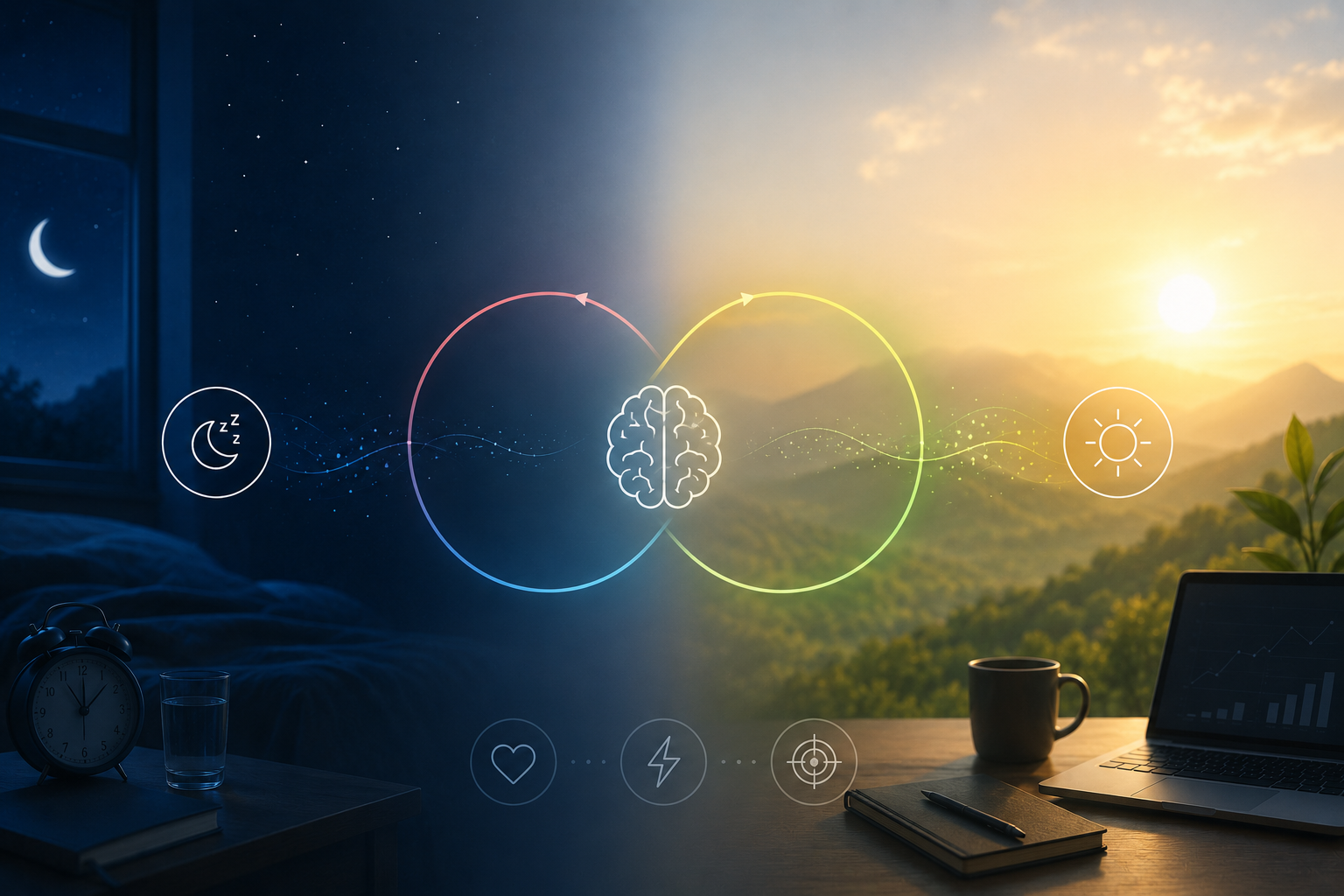
The throughline across all three: morning light → better circadian alignment → deeper sleep and steadier mood. It's a cascade, not a single effect — which is why it's so easy to miss if you're only watching one number.
What This Looks Like in Your Own Data
Here's where it gets concrete. This is the kind of pattern PeakRoutine's Health Map surfaces under Patterns We Noticed — the app cross-references your sunlight, mood, and sleep instead of showing them on three separate charts.
An example of the connection the Correlation AI flags:
Sunlight → Mood → Sleep · STRONG
Over a 5-day morning-sunlight streak, mood climbed from 50 to 79 (+58%), sleep quality rose to 85/100, and core sleep extended by about 27 minutes. The pattern points to a cascade: consistent pre-10am light exposure → better circadian alignment → deeper sleep → elevated mood.
No single screen in a typical health app would have connected those three. You'd have seen a slightly better sleep score and a better mood and never known the 20 minutes of morning light was the thread tying them together.
Why a Single Metric Would Have Missed It
Most trackers give you dashboards: sleep here, mood there, activity somewhere else. But your body doesn't experience these as separate systems — it responds to all of them at once. The insight isn't in any one metric; it's in the relationship between them.
That's the shift PeakRoutine is built around. Instead of handing you seven numbers to interpret, the Health Map connects them and tells you which lever is actually moving the others — in this case, morning light quietly anchoring both mood and sleep.
How to Put It to Work
1. Get bright light early — ideally before 10am.
Outdoor light is far stronger than indoor lighting even on an overcast day. Ten to twenty minutes is enough to start anchoring your clock.
2. Make it a streak, not a one-off.
The research and the in-app pattern both point the same way: consistency across several days is what shifts sleep and mood, not a single sunny morning.
3. Watch the downstream metrics, not just the habit.
After a few days of morning light, check whether your sleep depth and mood are trending up together. That co-movement is the signal that it's working for you.
4. Let the app close the loop.
When PeakRoutine detects the sunlight–mood–sleep link forming, it turns it into an adaptive habit — one that refreshes with your data rather than sitting on a static checklist. From there, your Sleep Coach can tell you exactly what your recent light-and-sleep trend is showing and what to adjust next.
The Takeaway
Morning light might be the highest-leverage, lowest-effort change available to your sleep — and it's the one variable most tools leave out entirely. The point isn't just to know that light matters; it's to see how it's shaping your nights specifically, before you write off a bad week of sleep as random.
See your own pattern. Open Patterns We Noticed in PeakRoutine to check how your sunlight, mood, and sleep are moving together — or ask your Sleep Coach what your recent trend is telling you.
References
- Boubekri, M., Cheung, I. N., Reid, K. J., Wang, C.-H., & Zee, P. C. (2014). Impact of Windows and Daylight Exposure on Overall Health and Sleep Quality of Office Workers: A Case-Control Pilot Study. Journal of Clinical Sleep Medicine, 10(6), 603–611. https://jcsm.aasm.org/doi/10.5664/jcsm.3780
- Figueiro, M. G., & Rea, M. S. (2017). The impact of daytime light exposures on sleep and mood in office workers. Sleep Health, 3(3), 204–215. https://pubmed.ncbi.nlm.nih.gov/28526259/
- He, M., Ru, T., Li, S., Li, Y., & Zhou, G. (2023). Shine light on sleep: Morning bright light improves nocturnal sleep and next morning alertness among college students. Journal of Sleep Research, 32, e13724. https://doi.org/10.1111/jsr.13724
This article is for educational purposes and is not medical advice. If you have concerns about your sleep, mood, or health, consult a qualified healthcare professional.
See your sunlight-sleep pattern for yourself.
PeakRoutine connects your sunlight, mood, and sleep so you can see which habits are actually moving the needle.
Download App