By the PeakRoutine Team · Reviewed for accuracy against peer-reviewed research
What Is Your Circadian Rhythm?
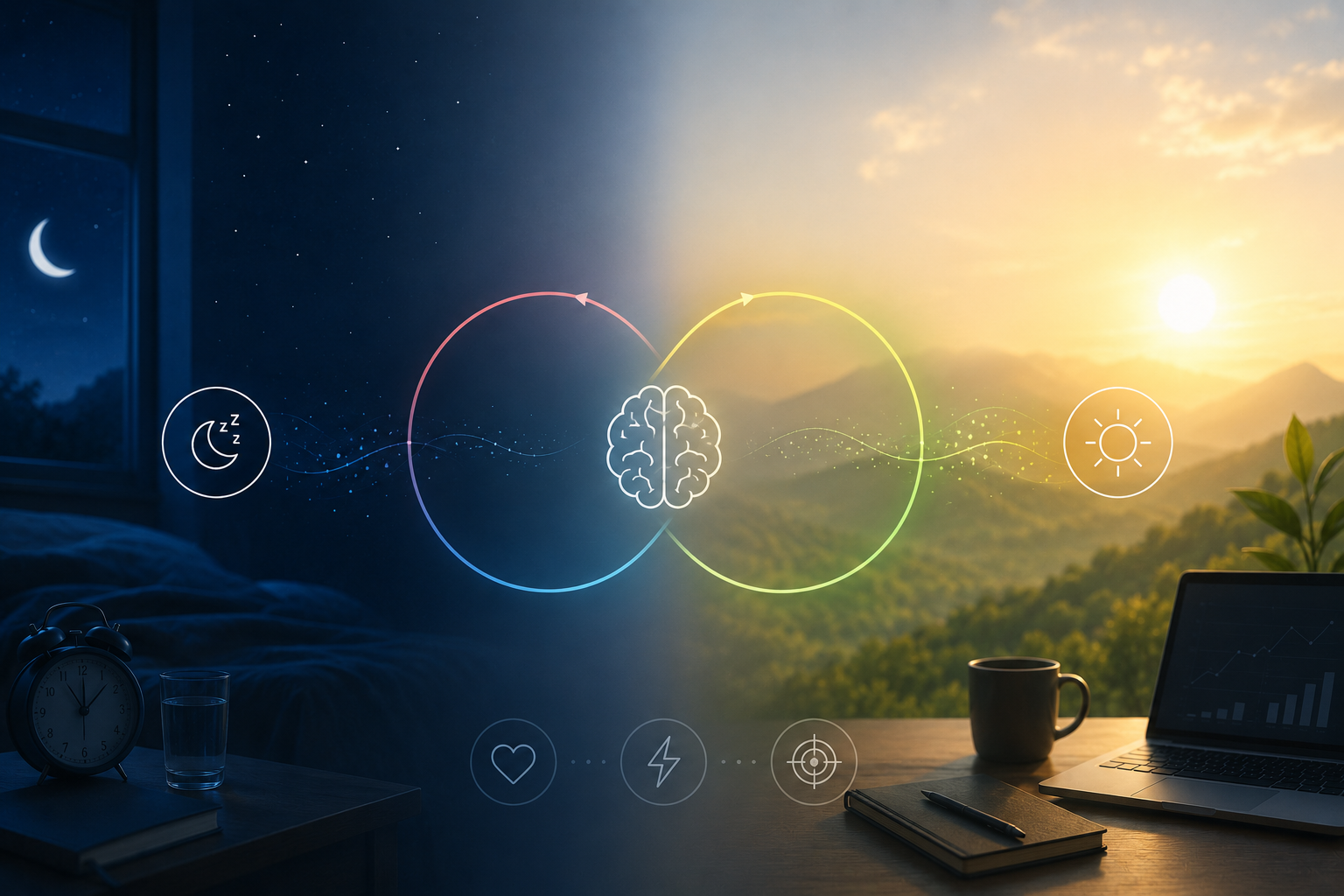
Your circadian rhythm is your body's internal 24-hour clock. It governs far more than when you feel sleepy — it drives daily rhythms in body temperature, hormone release, alertness, metabolism, and mood. When this clock is well-aligned with the outside world, you feel awake during the day and sleepy at night on a predictable schedule. When it drifts out of sync, sleep, energy, and mood all suffer.
The clock itself sits in a small region of the brain called the suprachiasmatic nuclei (SCN), and it doesn't keep perfect time on its own. It needs a daily cue to stay synchronized to the 24-hour day — and the strongest cue available is light (Blume, Garbazza & Spitschan, 2019[1]).
Why Light Is the Master Signal
Special cells in your eyes send light information directly to the SCN, which uses it to keep your internal clock aligned with the solar day (Blume et al., 2019[1]). This is a separate pathway from the one that lets you see — its job is timekeeping, not vision.
That's why light exposure is so powerful: it's the primary lever that tells your body what time it is. Get the right light at the right time and your clock stays anchored. Get bright light at the wrong time — like late at night — and it can shift your rhythm and disrupt sleep.
Morning Light vs Evening Light
Timing is everything, and the two ends of the day pull in opposite directions:
- Morning light anchors your clock. Bright light early in the day strengthens circadian alignment. In office workers, higher levels of morning circadian-effective light were linked to falling asleep faster and better sleep quality (Figueiro & Rea, 2017[2]), and greater overall daylight exposure was associated with longer, better-quality sleep (Boubekri et al., 2014[3]).
- Evening light delays it. Bright and blue-heavy light at night — screens, overhead lighting — can push your clock later and make it harder to fall asleep (Blume et al., 2019[1]).
The practical version: seek light in the morning, dim it in the evening.
Why Most Apps Miss This
Here's the gap. Your wearable probably tracks steps, heart rate, and sleep — but almost none track your light exposure, even though light is arguably the single biggest driver of when and how well you sleep. The most important input to your circadian health is usually the one that goes completely unmeasured.
That blind spot is exactly why two people with identical sleep habits can have very different sleep quality, and never figure out why. One got morning light; the other didn't.
How to Work With Your Body Clock
1. Get outside early.
Even 10–20 minutes of morning outdoor light helps anchor your clock. Outdoor light is far brighter than indoor lighting, even on a cloudy day.
2. Keep it consistent.
A regular light schedule matters as much as a regular sleep schedule — they reinforce each other.
3. Dim the evening.
Lower the lights and reduce screen brightness in the hour or two before bed to avoid pushing your clock later.
4. Anchor your wake time.
Waking at a consistent time and getting light soon after is one of the most reliable ways to stabilize a drifting rhythm.
How PeakRoutine Tracks Sunlight
Sunlight is a core signal in PeakRoutine precisely because it's so overlooked. The app treats daylight as its own domain on the Health Map and — more usefully — cross-references it against the things it influences. Its Correlation AI can surface patterns like morning light quietly lifting both your mood and your sleep depth, then turn that into an adaptive habit that updates with your data instead of sitting on a static checklist.
(For a concrete example of that connection in action, see Does Morning Light Really Improve Your Sleep? — the companion piece to this one.)
The Takeaway
Your circadian rhythm is one of the most powerful and most fixable levers in your health, and light is the switch. You don't need to overhaul your life — you need the right light at the right time, consistently. The hard part is seeing whether it's actually working for you, which is where measuring it changes everything.
See your own pattern. Open Patterns We Noticed in PeakRoutine to check how your sunlight, sleep, and mood move together — or ask your Sleep Coach what your recent light-and-sleep trend is telling you.
References
- Blume, C., Garbazza, C., & Spitschan, M. (2019). Effects of light on human circadian rhythms, sleep and mood. Somnologie, 23(3), 147–156. https://pubmed.ncbi.nlm.nih.gov/31534436/
- Figueiro, M. G., & Rea, M. S. (2017). The impact of daytime light exposures on sleep and mood in office workers. Sleep Health, 3(3), 204–215. https://pubmed.ncbi.nlm.nih.gov/28526259/
- Boubekri, M., Cheung, I. N., Reid, K. J., Wang, C.-H., & Zee, P. C. (2014). Impact of Windows and Daylight Exposure on Overall Health and Sleep Quality of Office Workers: A Case-Control Pilot Study. Journal of Clinical Sleep Medicine, 10(6), 603–611. https://jcsm.aasm.org/doi/10.5664/jcsm.3780
This article is for educational purposes and is not medical advice. If you have concerns about your sleep, mood, or health, consult a qualified healthcare professional.
Ready to see your own light-and-sleep pattern?
Download PeakRoutine today and let AI help you connect the dots between your sunlight, sleep, and mood.
Download App