
By the PeakRoutine Team · Reviewed for accuracy by Dr. Rajiv Gupta, MD
That gap is what this article closes. Habit stacking for health metrics works by using the one cue you already check every single morning — your readiness score, your HRV, your resting heart rate — as the anchor for a specific habit. Not "after I brush my teeth." The reading itself.
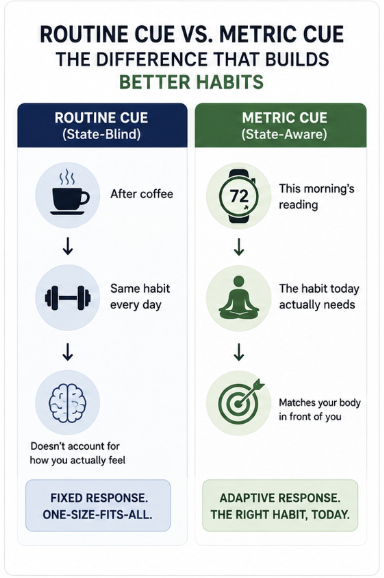
Most guides tell you to bolt a new habit onto an existing routine. That works, but it's blind to how your body actually is on a given day. A metric is not blind. It tells you which habit today needs — and that difference is the whole point.
What every guide to habit stacking for health metrics gets right (and the one thing it misses)
The core idea is sound, so let's give it its due in one breath: you attach a new behavior to an existing cue, and the cue triggers the behavior until it runs on its own. That's cue-based learning, and it works because your brain is piggybacking the new action onto a pathway it already trusts.
Here's the miss. In nearly every popular guide — Cleveland Clinic, the American Heart Association, the big fitness blogs — the anchor is a behavior: after coffee, after brushing your teeth, after you sit down to lunch. A behavioral anchor is state-blind. It fires "ten push-ups after coffee" whether you slept five hours or nine, whether you're fighting something off or fully recovered.
Your wearable hands you a different kind of anchor: a metric-triggered cue. The trigger is a reading, not a routine — so the habit you stack on top of it can match the body in front of you instead of an average version of you.
Why a wearable metric is a better cue than “after I brush my teeth”
Cue Consistency Is What Actually Builds the Habit
The most-cited number in habit science is 66 days — the average time it took people to reach "automaticity" in a landmark University College London study, though the real range ran from 18 to 254 days depending on the person and the behavior (Lally et al., 2010[6]).
The part that gets skipped is why it works. The same research found automaticity depends on repeating the behavior against a consistent context cue — same trigger, same setting, day after day. Very few cues in your life are as context-stable as a number that appears at the same moment, in the same app, every morning. That stability is exactly what the science says drives a habit home.
So while everyone else quotes the (mythical) 21 days, the honest answer is two months or so — and a metric that shows up on schedule every day is one of the most reliable anchors you can hang that two months on.
The Problem Isn't Motivation — It's the Intention–Behavior Gap
Knowing your HRV is low does not, by itself, change what you do. Behavioral science is blunt about this: knowledge alone does not produce behavior change (Lally et al., 2010[6]). What closes the gap is a concrete when-then plan.
A morning metric writes that plan for you. "I should manage my stress better" is a vague intention that dies by 10 a.m. "When my HRV reads below my baseline, then I do five minutes of slow breathing" is an implementation intention with a trigger attached — and the trigger is sitting on your lock screen.
A Metric Also Picks the Right Dose
A routine cue only tells you to act. A reading tells you how much. A deeply-in-the-red readiness score calls for a bigger response than a number that's a hair under baseline. Because the cue carries information, the right-sized habit arrives with it — something "after coffee" can never do.
The morning-metric stack: one habit for each number
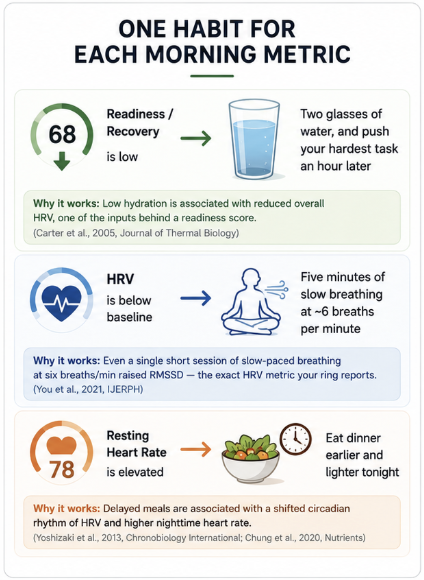
Here's the practical core. Pick the reading that matters most to your goal, and stack one habit onto it. One — not four.
| This morning's reading | Stack this habit onto it | Why it holds up |
|---|---|---|
| Readiness / recovery is low | Two glasses of water, and push your hardest task an hour later | Dehydration is associated with reduced overall HRV, one of the inputs behind a readiness score (Carter et al., 2005[1]); starting the day hydrated and deferring hard effort supports the body's own recovery. |
| HRV is below your baseline | Five minutes of slow breathing at ~6 breaths per minute | Even a single short session of slow-paced breathing at six breaths/min raised RMSSD — the exact HRV metric your ring reports — compared with normal breathing (You et al., 2021[2]). |
| Resting heart rate is elevated | Eat dinner earlier and lighter tonight | Delayed mealtimes are associated with a shifted circadian rhythm of the autonomic nervous system, measured via HRV (Yoshizaki et al., 2013[3]), and eating within three hours of bed is linked to more nocturnal awakenings (Chung et al., 2020[4]) |
| Deep sleep ran short | 10–15 minutes of morning daylight, and protect tonight's wind-down | In an office-worker field trial, a week of morning bright light improved nocturnal sleep efficiency and next-morning alertness (He et al., 2023[5]), largely by anchoring circadian timing. |
Every row is a when-then plan. The point of "one, not four" is straight from the research: overly ambitious, multi-habit stacks are the ones that collapse. You're building a trigger, and a trigger only forms when it fires cleanly and repeatedly.
Notice these are things you do because of a number, not things you obsess over. The number's job is to fire the habit, then get out of the way.
If you want the layer underneath this — deciding what kind of day it is before you pick the habit — that's a recovery routine that adapts each morning.
Start With One Metric, Not Four
Choose the single reading that best reflects what you're chasing right now — HRV if you're managing stress and training load, RHR if you're cleaning up your evenings, readiness if you just want a daily go/no-go. Run that one stack for about two months before you add a second. That timeline isn't padding; it's the 66-day automaticity horizon doing its work. Anyone promising you 21 days is selling the myth.
Two things make that two months easier. First, keep the habit small enough that it's almost embarrassing to skip — five minutes of breathing, not a 30-minute session. The point early on is to fire the cue-to-action link reliably, and a small action fires more reliably than an ambitious one. Second, don't let one miss derail you. In the same UCL data, missing a single day did not meaningfully reduce the odds of a habit forming (Lally et al., 2010[6]) — it's overall consistency that counts, not a perfect streak. Skip a morning, and just run the stack again the next time the cue appears.
A worked example: one metric, eight weeks
Take a time-poor professional who picks HRV as their trigger. The rule is simple: on any morning HRV reads below baseline, they do five minutes of slow breathing before the first meeting. That's it. No new app to open, no willpower budget — the low reading is the reminder.
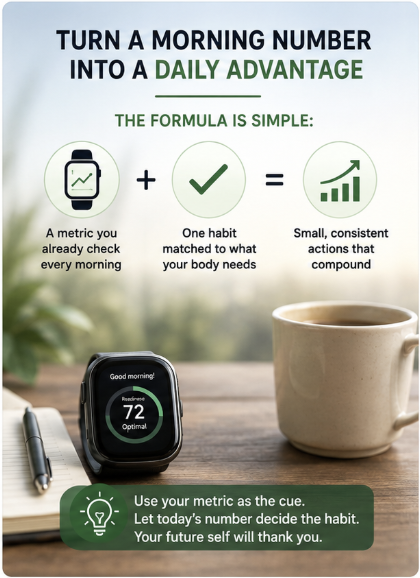
The reason this works where a generic resolution fails is that the loop closes on itself: the reading is the cue, the breathing is the habit, and tomorrow's reading is the feedback that tells you whether it landed. Cue → habit → feedback, every day. That flywheel is the thing a "meditate more in 2026" goal never has — there's nothing measuring whether it happened or whether it helped.
Here's what two years of building in this space taught me: the people who actually change their behavior aren't the ones with the most data — they're the ones whose data tells them the single next thing to do. Everyone else is just collecting evidence of a problem they already know they have.
Where this is going
The manual version genuinely works, and you can start it tomorrow with the wearable you already own. The friction is only ever two things: remembering to notice the cue, and knowing the right habit for that specific number. That's the gap PeakRoutine is built to close — it reads your wearable and bloodwork together and turns each morning's numbers into the specific next move, so the metric-triggered stack runs without you having to design it. If you'd rather not assemble the system by hand, that's what the app is for.
But the principle stands with or without us: stop treating your morning number as a scoreboard, and start treating it as a starting gun.
Frequently asked questions
How long does it take for a stacked habit to become automatic?
On average about 66 days, but the real range is 18 to 254 days depending on the person and how complex the habit is (Lally et al., 2010[6]). The popular "21 days" figure has no research behind it. Expect roughly two months of consistent repetition, and know that the earliest reps give you the biggest gains.
Can I habit stack with an Oura Ring, Apple Watch, or WHOOP?
Yes — that's the entire idea here. Whatever your device surfaces each morning (Oura's Readiness, WHOOP's Recovery, Apple's overnight HRV, Garmin's Body Battery) becomes your cue. The number appears at the same time every day, which makes it a more context-stable anchor than "after breakfast," and stability is what the research says builds automaticity fastest.
What if my metrics are noisy from one day to the next?
Act on the trend against your personal baseline, not a single reading. One low HRV night after a late dinner isn't a signal; three below-baseline mornings in a row is. Trigger the habit off "below my baseline," not off any specific number, and the day-to-day noise stops mattering.
References
- Carter, R., Cheuvront, S. N., Kolka, M. A., Stephenson, L. A., & Sawka, M. N. (2005). The influence of hydration status on heart rate variability after exercise heat stress. Journal of Thermal Biology, 30(7), 495–502. https://doi.org/10.1016/j.jtherbio.2005.05.006
- You, M., Laborde, S., Zammit, N., Iskra, M., Borges, U., & Dosseville, F. (2021). Single Slow-Paced Breathing Session at Six Cycles per Minute: Investigation of Dose-Response Relationship on Cardiac Vagal Activity. International Journal of Environmental Research and Public Health, 18(23), 12478. https://doi.org/10.3390/ijerph182312478
- Yoshizaki, T., Tada, Y., Hida, A., et al. (2013). Influence of dietary behavior on the circadian rhythm of the autonomic nervous system as assessed by heart rate variability. Physiology & Behavior, 118, 122–128. https://doi.org/10.1016/j.physbeh.2013.05.010
- Chung, N., Bin, Y. S., Cistulli, P. A., & Chow, C. M. (2020). Does the Proximity of Meals to Bedtime Influence the Sleep of Young Adults? A Cross-Sectional Survey of University Students. International Journal of Environmental Research and Public Health, 17(8), 2677. https://doi.org/10.3390/ijerph17082677
- He, M., Ru, T., Li, S., Li, Y., & Zhou, G. (2023). Shine light on sleep: Morning bright light improves nocturnal sleep and next morning alertness among college students. Journal of Sleep Research, 32, e13724. https://doi.org/10.1111/jsr.13724
- Lally, P., van Jaarsveld, C. H. M., Potts, H. W. W., & Wardle, J. (2010). How are habits formed: Modelling habit formation in the real world. European Journal of Social Psychology, 40(6), 998–1009. https://doi.org/10.1002/ejsp.674
This article is for informational purposes only and is not medical advice. Reviewed for accuracy by Dr. Rajiv Gupta, MD.
Let your wearable write the plan for you.
PeakRoutine reads your wearable and bloodwork together and turns each morning's numbers into the specific next move.
Download App