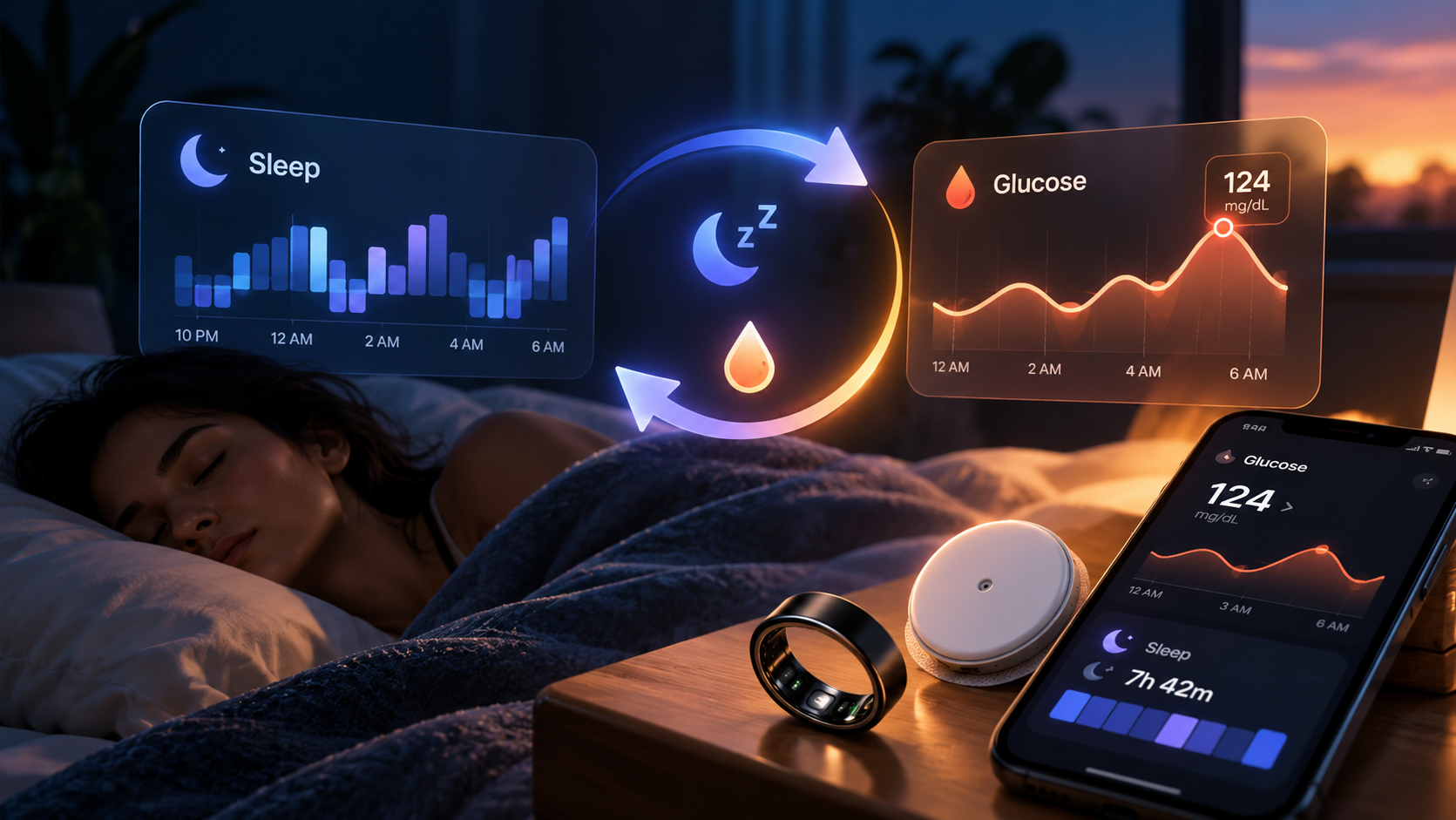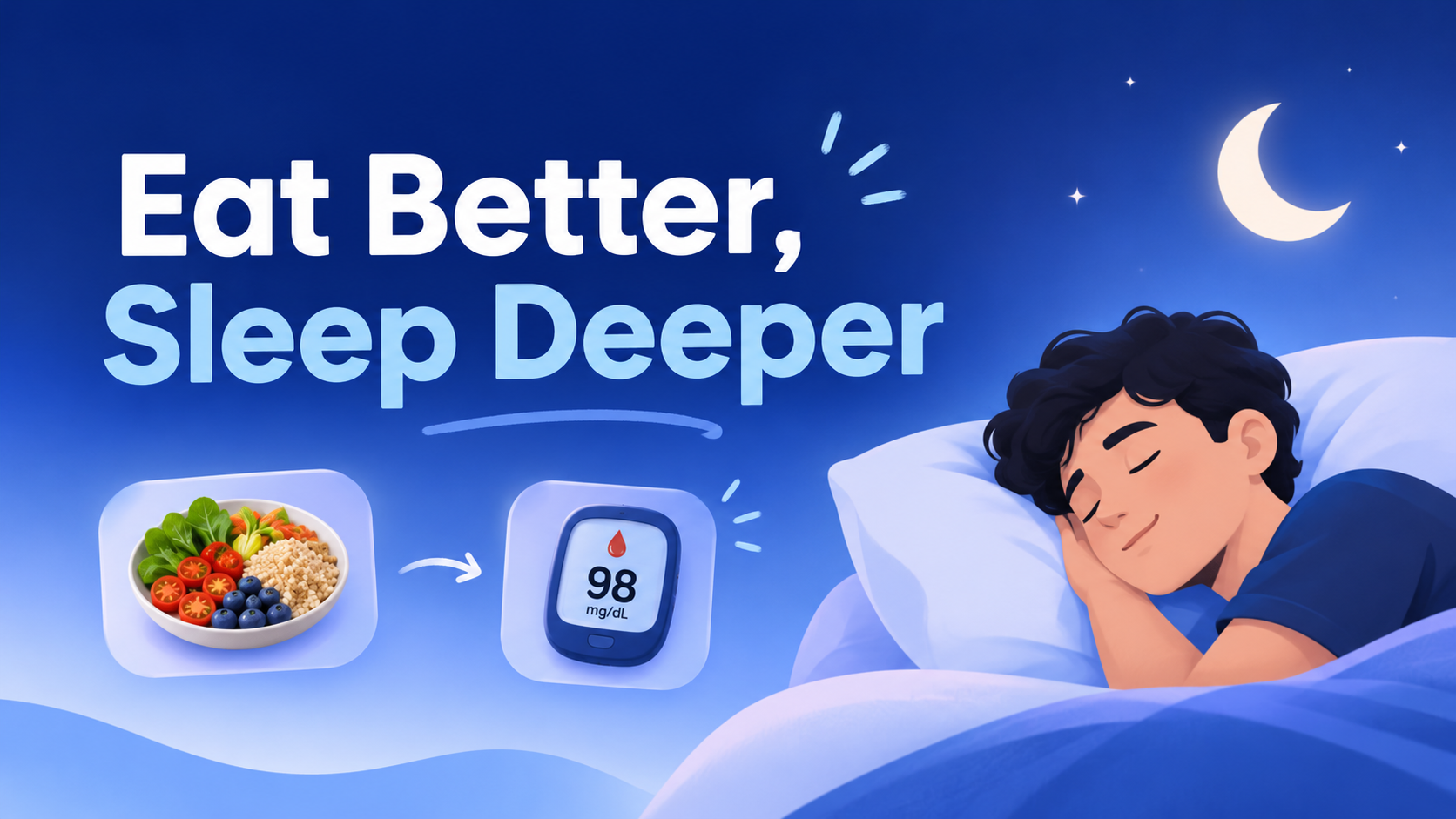
You can do everything else right — dark room, cool temperature, no screens — and still wreck your sleep with dinner timing. A late, heavy meal sets off a chain of digestion, body-temperature, and glucose events that collide with the physiology your body is trying to run while you sleep. And like caffeine, the cost often hides in your sleep quality rather than keeping you awake.
This post covers how late eating affects your sleep, the glucose connection specifically, and how to find your own "kitchen closes" time using your data.
Why late meals disrupt sleep
Several mechanisms stack up when you eat close to bedtime:
Digestion competes with winding down
Processing a large meal keeps your metabolism and digestive system active at exactly the time your body is trying to power down for sleep.
Core temperature rises
Eating raises core temperature slightly (the "thermic effect of food"), and a falling core temperature is one of the signals that helps start and deepen sleep.
Glucose surges at the wrong time
A large or carb-heavy late meal triggers a glucose spike and insulin response right as you're trying to sleep.
That last one matters most. As we've covered in depth, overnight glucose swings are linked to more fragmented, less efficient sleep. Eating late loads the system precisely when you don't want volatility.
A 2026 study examining later dinner timing in healthy young women found it affected subsequent metabolic function and nocturnal sleep — direct evidence that when you eat, not just what, shapes the night (Enomoto et al., 2026[1]).
The glucose and deep-sleep connection
Deep (slow-wave) sleep is the most physically restorative stage — when much of your recovery happens. It's also the stage most sensitive to disruption from a volatile overnight glucose profile.
When a late meal drives a glucose spike followed by a reactive dip, that instability can coincide with awakenings and pull you out of deep sleep. The relationship runs both ways: unstable overnight glucose fragments sleep, and poor sleep worsens next-day glucose handling. Eating late is one of the most direct ways to introduce that overnight volatility.
There's a nuance worth knowing: meal composition interacts with timing. High-glycemic-index carbohydrate meals have been shown to shorten the time it takes to fall asleep when eaten four hours (not minutes) before bed (Afaghi et al., 2007[2]) — but that's about sleep onset, not quality, and it doesn't license a large high-GI meal right at bedtime. The practical reading: timing and composition both matter, and "large, late, and sugary" is the combination to avoid.
Finding your "kitchen closes" time
The common guidance is to finish eating about 2–3 hours before bed, which gives digestion time to settle and your glucose to normalize. But your ideal window is personal — here's how to find it from your data:
- Start with a 3-hour buffer. For an 11 p.m. bedtime, aim to finish dinner by around 8 p.m. and hold it for a week.
- Watch deep sleep and fragmentation. Compare nights where you ate early against nights you ate late. If early-dinner nights show more deep sleep and fewer awakenings, you've confirmed the lever on your own body.
- Separate timing from size. If you can't always eat early, test whether a smaller, lighter late meal behaves better than a large one — often it does.
- Mind the late-night snack trap. A sugary snack right before bed is a glucose spike at the worst moment. If you need something, a small, protein- or fat-leaning snack is gentler than something high-GI.
- Account for the loop. A late meal that worsens tonight's sleep also tends to worsen tomorrow's glucose handling — so the pattern compounds, and so does the benefit of fixing it.
A few realistic notes
- Don't go to bed hungry either. Genuine hunger can disrupt sleep too; the goal is an adequate, earlier dinner, not under-eating.
- Alcohol compounds everything. An evening drink affects both glucose handling and sleep architecture, stacking on top of a late meal's effects.
- Shift workers and late schedules face a harder version of this; the principle (earlier relative to your sleep, lighter when late) still applies.
The bigger picture
Meal timing is one of the highest-leverage, lowest-effort sleep levers — you're not adding anything, just moving dinner earlier. The reason it's easy to miss is the same reason caffeine is: the cost shows up as quietly reduced deep sleep rather than an obvious inability to fall asleep — one more reason you can wake up tired after a full night in bed.
PeakRoutine makes that link visible — reading your meal timing against your deep sleep, sleep fragmentation, and (where you track it) overnight glucose, so you can see what your late dinners actually cost and set a "kitchen closes" time based on your own nights, not a generic rule.
FAQ
How long before bed should I stop eating?
A common, reasonable guideline is to finish eating about 2–3 hours before bed, giving digestion time to settle and glucose to normalize before sleep. But the ideal window is individual — testing early-dinner nights against late-dinner nights in your own sleep data (watching deep sleep and awakenings) is the reliable way to find your personal "kitchen closes" time.
Why do I sleep worse after a late dinner?
Several mechanisms stack up: active digestion competes with winding down, eating raises core body temperature (working against the drop that deepens sleep), and a late meal triggers a glucose and insulin surge that can introduce overnight volatility linked to fragmented, less efficient sleep. Large, late, carb-heavy meals are the worst combination.
Does eating late affect deep sleep specifically?
It can. Deep (slow-wave) sleep is sensitive to overnight glucose instability, and a late meal's spike-and-dip glucose pattern can coincide with awakenings that pull you out of deep sleep. Since deep sleep is the most physically restorative stage, protecting it by eating earlier is a meaningful recovery lever.
References
- Enomoto M, Kitamura S, Kunieda T, et al. Effects of later dinner timing on subsequent metabolic function and nocturnal sleep in healthy young women. Journal of Physiological Anthropology. 2026. https://pubmed.ncbi.nlm.nih.gov/41975458/
- Afaghi A, O'Connor H, Chow CM. High-glycemic-index carbohydrate meals shorten sleep onset. American Journal of Clinical Nutrition. 2007;85(2):426–430. https://www.sciencedirect.com/science/article/pii/S0002916523279290