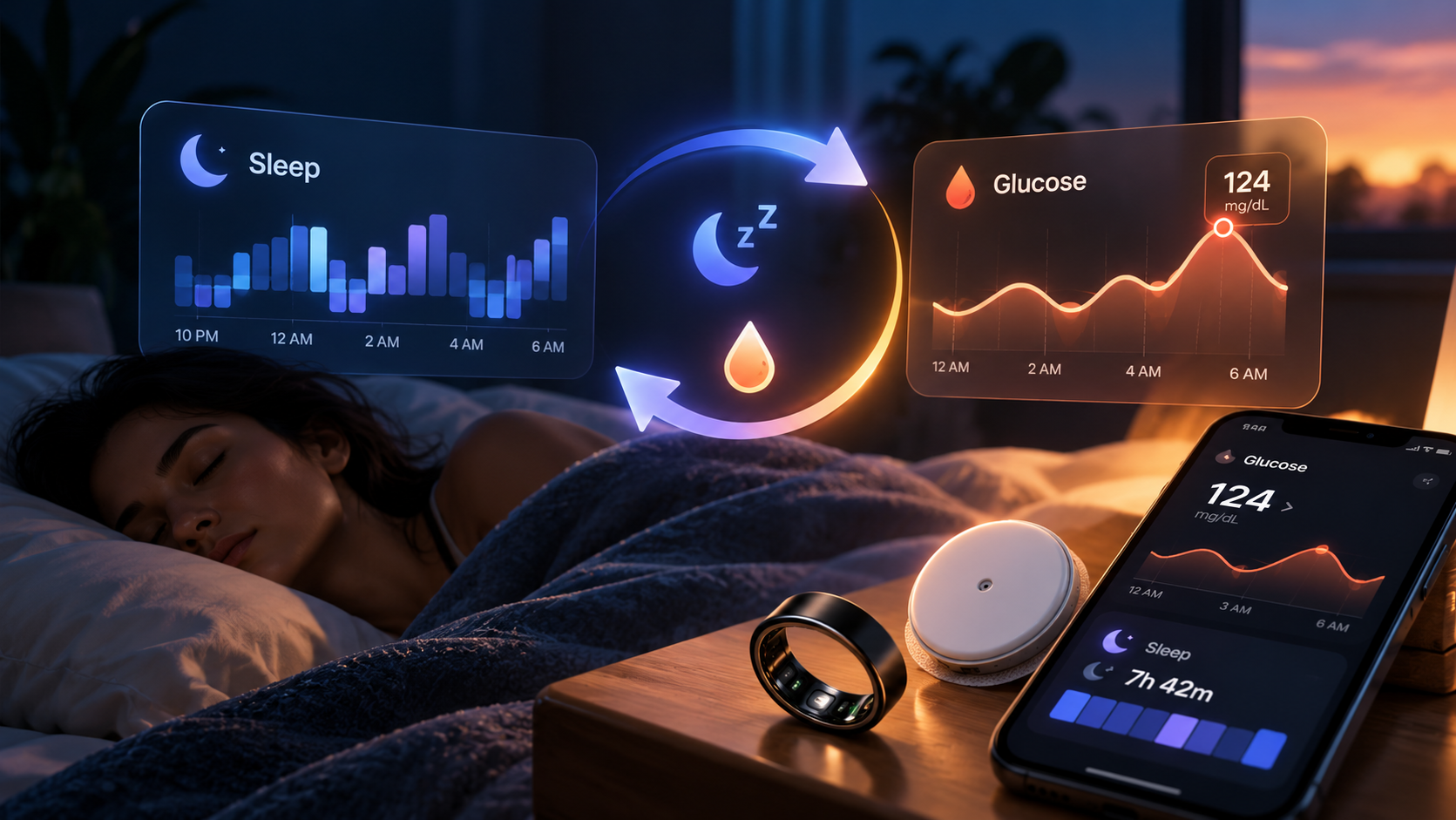
Your wearable is excellent at telling you how you slept — duration, stages, efficiency. What it can't tell you is one of the biggest hidden drivers of why a night went the way it did: what your blood sugar was doing while you slept. That's a real gap, because sleep and overnight glucose influence each other in a tight two-way loop. A high-glucose night can fragment your sleep; a bad night can push the next day's glucose up.
This is one of the clearest cases where two data streams are better than one — your ring sees the sleep, a continuous glucose monitor (CGM) sees the sugar, and the insight lives in the overlap. Here's what that overlap reveals.
The two-way loop, in plain terms
Sleep and glucose regulation aren't separate systems — they feed back into each other overnight.
- Direction one: glucose affects sleep. Overnight glucose swings — both highs and dips — are associated with more fragmented, less efficient sleep. When blood sugar is unstable at night, sleep continuity suffers.
- Direction two: sleep affects glucose. Poor or short sleep impairs how your body handles glucose, nudging the next day's levels higher and less stable. Sleep loss reduces insulin sensitivity, which is why a run of bad nights can show up as worse glucose control.
Put together, it's a loop: unstable overnight glucose → worse sleep → worse next-day glucose regulation → and around again. Breaking the loop at either point helps the other — but you can only see the loop if you're watching both signals.
What the data actually shows
This isn't theoretical. One of the largest real-world datasets on the topic analyzed 227,860 nights of simultaneous smart-ring sleep data and CGM glucose data across nearly 5,900 adults. Nights with higher sleep quality were characterized by lower overnight glucose, more stable glucose profiles, and more time in the healthy glucose range. Poorer sleep quality went the other way: higher and more variable nocturnal glucose (medRxiv preprint, 2026[1]). Note that this is a preprint and has not yet been peer reviewed.
A 2026 study in the Journal of Sleep Research found the same directional link in adults with type 2 diabetes: poor sleep quality was independently associated with more time above the target glucose range, less time in range, and greater glucose variability (Nam et al., 2026[2]).
And zooming into the night itself, a multi-night home sleep study in children and adolescents with type 1 diabetes examined how nocturnal glycemic variability relates to sleep architecture — the question of whether swings in the night track with how sleep is structured (Paulsrud et al., 2026[3]).
A note on context: much of this research involves people managing diabetes, where the glucose–sleep relationship is most pronounced. The large smart-ring dataset spans a broader adult population, and the underlying physiology — glucose stability shaping sleep, and sleep shaping glucose — is general. But effect sizes in people without diabetes may be smaller, so treat these patterns as things to test in your own data.
What your wearable misses on its own
Your ring or watch can tell you that you woke up four times last night and spent less time in deep sleep. What it can't tell you is that a 2 a.m. glucose dip was what woke you, or that the late, carb-heavy dinner you ate drove a spike that fragmented your first sleep cycle.
That's the specific blind spot a CGM fills. On its own, a wearable leaves you guessing at the cause of a bad night. Paired with glucose data, patterns become legible:
Late, large meals
An overnight glucose spike, then a reactive dip — often showing up as fragmented early sleep.
Alcohol before bed
Disrupted glucose handling and suppressed sleep quality, compounding each other.
A poor night, for any reason
A visibly higher, more variable glucose curve the following day.
None of these are visible from sleep staging alone. They emerge only when you lay the two curves over each other.
How to read them together
You don't need to be managing a medical condition to learn from this pairing. If you have access to both a wearable and a CGM (or run a periodic CGM stint), here's how to extract signal:
- Overlay the two overnight curves. Line up last night's glucose trace against your sleep timeline. Look for glucose spikes or dips that coincide with awakenings or drops out of deep sleep.
- Test one variable at a time. Try an earlier dinner for a few nights and watch whether your overnight glucose flattens and your sleep continuity improves. Then try moving or removing a pre-bed drink. Change one thing, read both signals.
- Judge by the trend, not one night. A single spiky night is noise. A repeated pattern — late meals consistently preceding fragmented nights — is a lever worth pulling.
- Watch the next day, too. The loop runs forward: a poor night often shows up as a higher, less stable glucose day. Seeing that confirms the connection in your own body.
The point: the insight lives between the devices
A sleep tracker answers "how did I sleep?" A CGM answers "what did my glucose do?" Neither answers the more useful question — "what's driving my sleep, and what can I change tonight?" — because that answer lives in the relationship between the two. It's the same question behind feeling tired after a full night in bed: the cause is rarely visible in a single dashboard.
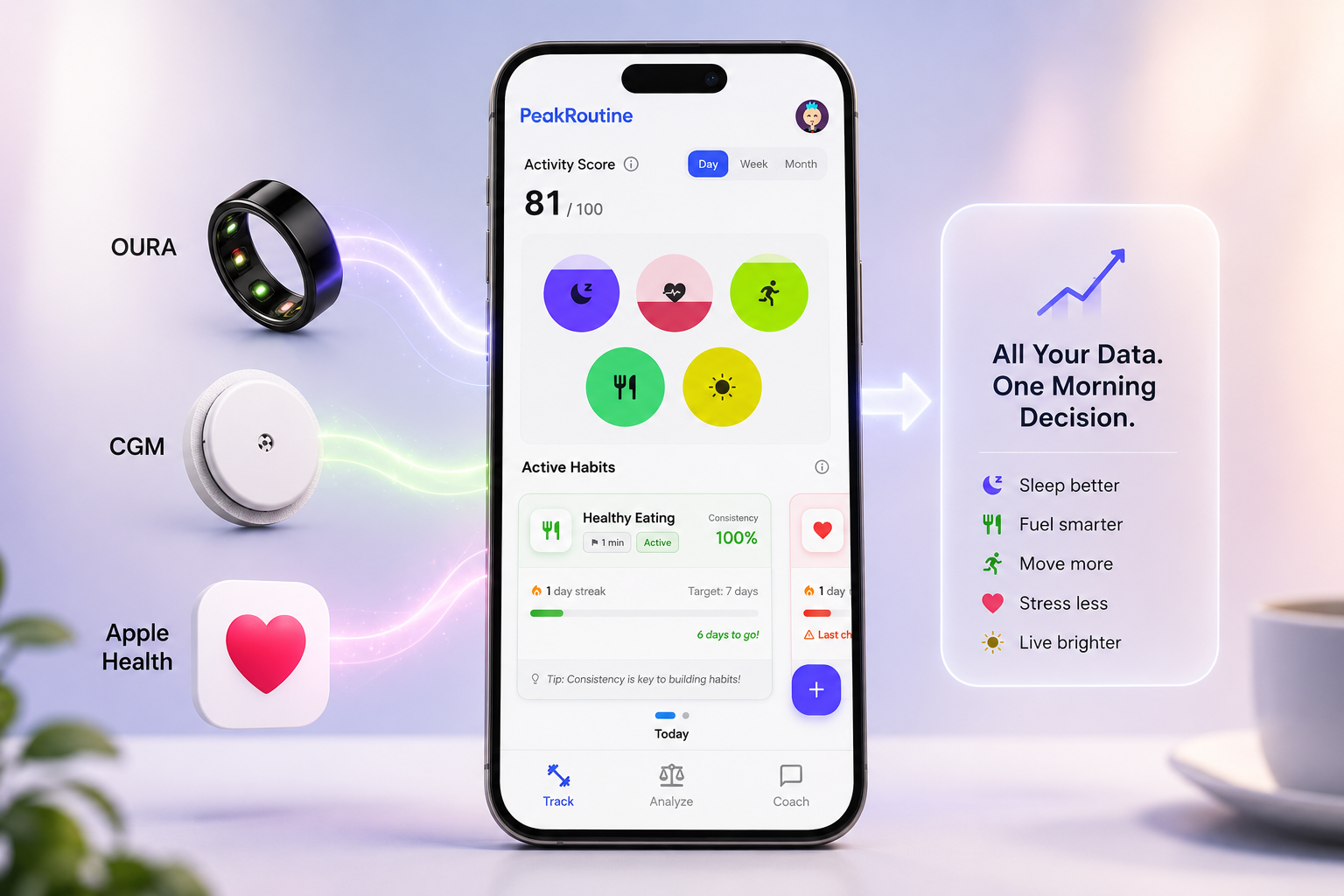
This is exactly the cross-source picture PeakRoutine is built for: correlating your sleep data and your glucose data (alongside HRV, activity, and the habits you log) so the overnight loop becomes visible and, more importantly, actionable. The devices each capture a piece. The value is in reading them as one.
FAQ
Does blood sugar affect sleep quality?
Yes — the relationship runs both ways. Research links unstable overnight glucose (both spikes and dips) to more fragmented, less efficient sleep, and separately links poor sleep to higher and more variable next-day glucose. A large real-world study of smart-ring and CGM data found higher sleep quality was associated with lower, more stable overnight glucose and more time in the healthy range.
Why do I wake up in the middle of the night for no reason?
There are many possible causes, but one your sleep tracker can't see on its own is an overnight glucose swing. A dip or spike in blood sugar — often following a late, large, or carb-heavy meal or evening alcohol — can coincide with awakenings and drops out of deep sleep. Pairing sleep data with a continuous glucose monitor can reveal whether glucose is a factor for you. Persistent unexplained waking is worth discussing with a doctor.
Do I need a CGM if I already have a sleep tracker?
Not necessarily — but they answer different questions. A sleep tracker tells you how you slept; a CGM tells you what your glucose did overnight. The useful insight is in the overlap: whether glucose swings are fragmenting your sleep, or poor sleep is worsening your glucose. Even a short periodic CGM stint, read alongside your wearable, can surface patterns neither device shows alone.
References
- Sleep quality and overnight glucose in 227,860 nights of paired smart-ring and continuous glucose monitor data. medRxiv preprint, 2026 (not peer reviewed). doi:10.64898/2026.03.04.26347496. https://www.medrxiv.org/content/10.64898/2026.03.04.26347496v1.full
- Nam S, et al. Associations between sleep quality and continuous glucose monitoring-derived metrics in individuals with type 2 diabetes. Journal of Sleep Research. 2026. https://pubmed.ncbi.nlm.nih.gov/41902329/
- Paulsrud C, et al. Nocturnal glycemic variability and sleep architecture in children and adolescents with type 1 diabetes: a multi-night home sleep study. Sleep Medicine. 2026. https://pubmed.ncbi.nlm.nih.gov/42241891/