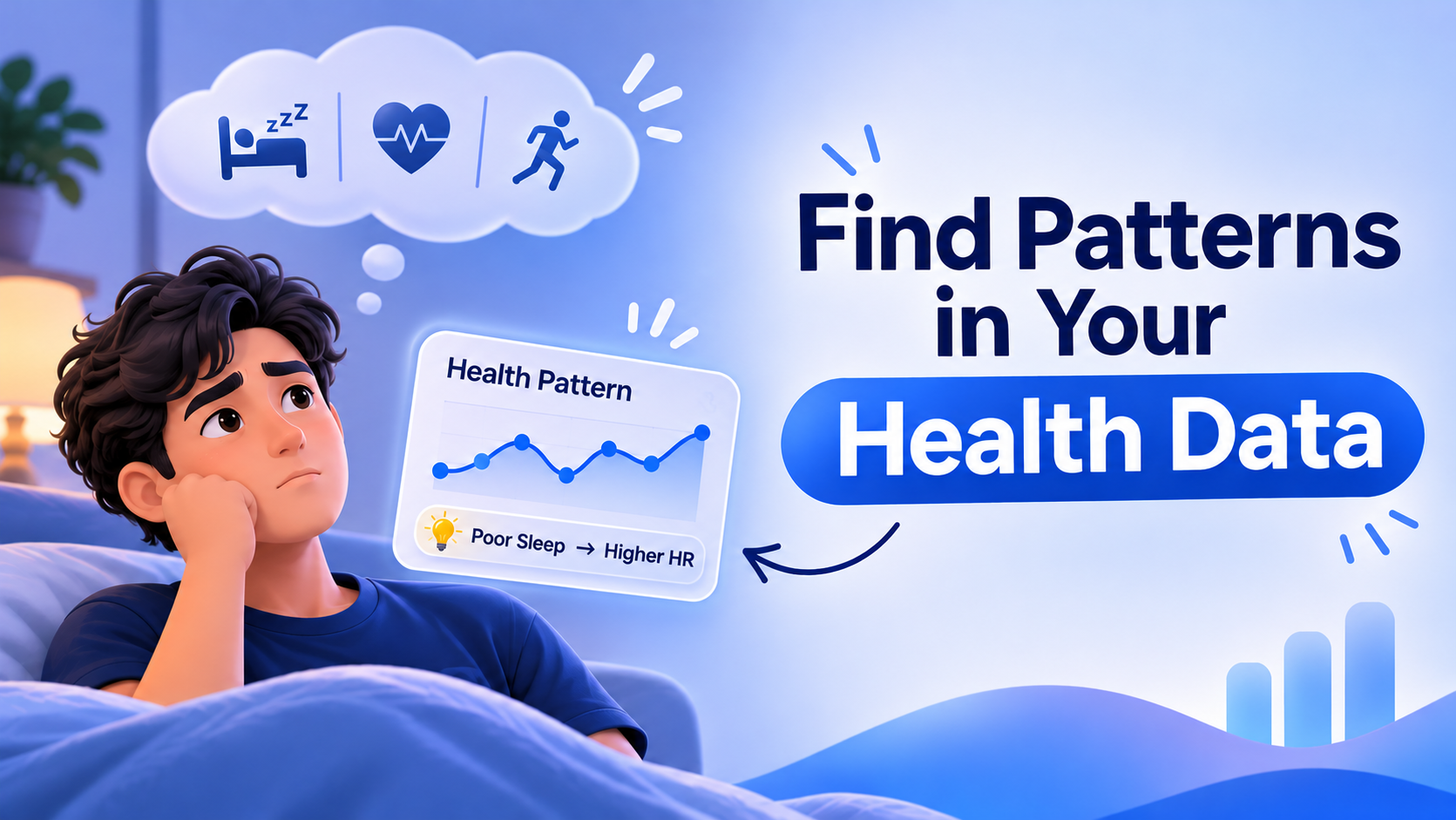
Most mood tracking dead-ends at the log itself: you tap "meh," it goes in a diary, and nothing comes of it. But mood rarely arrives out of nowhere. It sits downstream of things you're already measuring — how you slept, how much you moved, how recovered your body is — and when you line those up next to your mood, the "random" bad day often turns out to be anything but.
This post is about that overlay: why mood tracking becomes genuinely useful only when it's read against your physiological data, and the specific patterns that tend to surface.
Why a standalone mood log falls flat
Logging your mood in isolation tells you that Tuesday was rough. It doesn't tell you why, and the "why" is the only part you can act on. Was it a short night? A skipped workout? Three days of accumulating fatigue? Without context, a mood log is a record of symptoms with no link to causes.
The shift happens when mood becomes one layer in a stack: mood on top, and underneath it sleep, activity, HRV, and resting heart rate for the same day and the days before. Now a dip isn't a mystery — it's the visible end of a chain you can trace backward. That's the difference between journaling how you feel and actually understanding it.
The patterns that actually show up
Sleep → next-day mood
This is the most reliable one. Poor or short sleep tends to flatten mood and shorten your fuse the following day, and the relationship is bidirectional — low mood can also disrupt the next night's sleep, creating a loop. Research tracking people in everyday settings found physical activity, sleep, and affect move together day to day in reciprocal relationships — each one nudges the others (Lee et al., 2024[1]).
If your mood logs consistently dip the day after a bad night, you've found one of your biggest levers — and it's a fixable one.
Movement → mood
Physical activity is one of the most consistent mood regulators there is. A 2024 study examining activity in naturalistic environments found measurable associations between physical activity and both sleep architecture and mood (Zapalac et al., 2024[2]). In practice this shows up as a simple pattern in your own data: active days often log better moods, sedentary stretches often precede worse ones.
Recovery state → mood
Your mood frequently tracks your autonomic recovery. A run of suppressed HRV or an elevated resting heart rate — the body under strain — often coincides with lower mood, because the same physiological stress load affects both. When mood drops and recovery markers are down together, the message is usually "you're depleted," not "something's wrong with your character."
The lag effect
The most useful pattern is often delayed. Today's low mood may trace to a short night two days ago, or to a week of under-recovery finally catching up. Mood responds on a lag, which is exactly why a single day in isolation misleads and a multi-day overlay reveals.
How to track mood so it's actually useful
- Log consistently, at a consistent time. Once a day, ideally around the same time (evening works well), so the signal isn't distorted by when you logged.
- Keep the scale simple. A 1–5 or a few emoji beats elaborate scales — you'll actually keep it up, and consistency matters more than granularity.
- Don't judge the entry. The value is in the record, not in feeling good about it. An honest "bad day" logged is worth more than a flattering one skipped. (This is why good systems grade mood tracking on whether you logged, not what you logged.)
- Read it against your data weekly, not daily. Once a week, scan your mood row against sleep, activity, and recovery. Look for the repeated alignment — the pattern that shows up again and again is your lever.
- Look back 1–3 days, not just same-day. Account for the lag. The cause is often earlier than the dip.
An important boundary
This is about everyday mood patterns — the ordinary ebb and flow that tracks with sleep, movement, and stress. It is not a tool for diagnosing depression, anxiety, or any mental-health condition, and persistent low mood is not something to troubleshoot with a wearable. If low mood lasts for weeks, doesn't lift with better sleep and activity, or comes with hopelessness or loss of interest in things you normally enjoy, that's a reason to talk to a doctor or mental-health professional — not to log another data point. Mood tracking here is a wellness habit, not a clinical instrument.
The bigger picture
Mood feels like the least measurable thing about a day — until you put it on top of the things you can measure. Then the pattern usually appears: the bad days cluster after bad nights, after sedentary stretches, after your recovery markers have been quietly sliding. That turns mood from something that happens to you into something with visible, often addressable causes.
That overlay is what PeakRoutine is built for: your mood logs read against your sleep, activity, and recovery in one place, so a low day comes with its likely explanation attached — and you can act on the cause instead of just recording the symptom.
FAQ
Can my health data really explain my mood?
It can explain a meaningful part of everyday mood variation. Sleep quality, physical activity, and recovery state (HRV, resting heart rate) all have well-documented relationships with mood, and research shows they move together day to day in both directions. Overlaying your mood logs on these signals often reveals repeatable patterns — like consistently lower mood after poor sleep — that point to specific, fixable causes. It does not explain or diagnose clinical mental-health conditions.
Why is my mood worse some days for no reason?
There's often a reason — it's just on a lag or buried in data you're not reading together. A low mood today may trace to a short night a day or two ago, a sedentary stretch, or accumulating under-recovery. Tracking mood alongside sleep, activity, and recovery, and looking back a few days rather than only at today, tends to surface the cause.
How should I track my mood effectively?
Log once a day at a consistent time using a simple scale, record honestly without judging the entry, and — most importantly — review your mood against your sleep, activity, and recovery data weekly rather than reading entries in isolation. The insight is in the overlay and the repeated pattern, not the single log.
References
- Lee SA, Fisher Z, Almeida DM. Daily reciprocal relationships between affect, physical activity, and sleep in middle and later life. Annals of Behavioral Medicine. 2024. https://pmc.ncbi.nlm.nih.gov/articles/PMC11783308/
- Zapalac K, et al. The effects of physical activity on sleep architecture and mood in naturalistic environments. Scientific Reports. 2024. https://www.nature.com/articles/s41598-024-56332-7