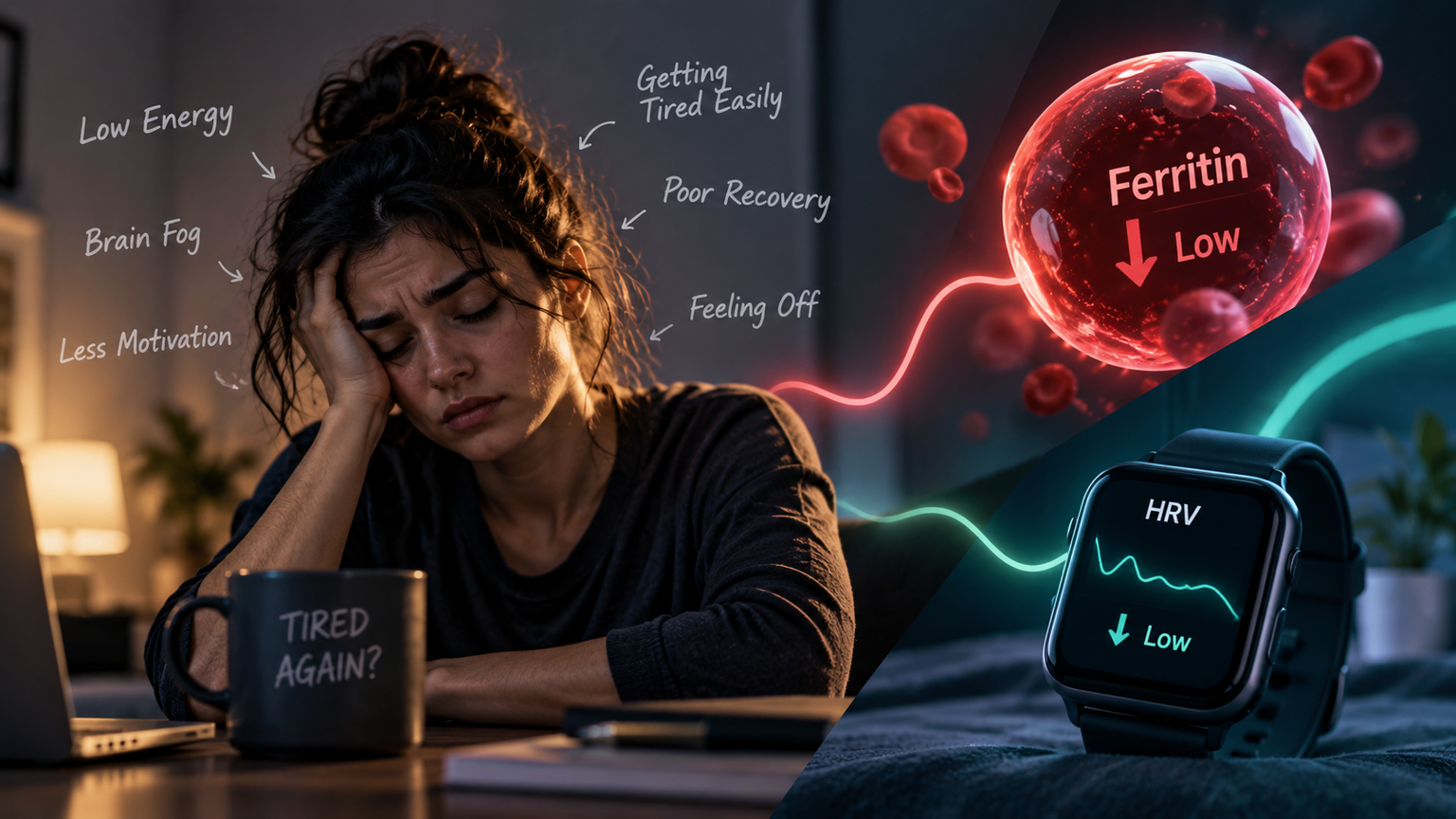
You feel exhausted. Your recovery score is low. Your HRV has been suppressed for two weeks straight — but your sleep looks fine, your training load hasn't changed, and you don't have a cold. Your wearable keeps flagging the signal; you keep wondering what's causing it.
One answer that most wearable dashboards never surface: your ferritin might be low.
Ferritin is a blood marker — a protein that stores iron in your cells. Your ring or watch has no sensor for it. But iron deficiency affects the autonomic nervous system in ways that show up clearly in HRV data, often weeks before you'd think to order a blood test. That gap — between what the wearable sees and what it can explain — is exactly where misreading your data happens.
This post explains the biology, shows you what the pattern looks like in practice, and tells you what to do if you recognise it.
Why ferritin and HRV are connected
HRV — heart rate variability — is a measure of how well your autonomic nervous system is functioning. Specifically, it reflects the balance between the sympathetic (stress-response) and parasympathetic (rest-and-digest) branches of your nervous system. When that balance is healthy, the intervals between heartbeats vary naturally. When something is stressing the system — illness, overtraining, poor sleep — HRV drops. (If you want the primer first, start with the basics of heart rate variability.)
Iron is essential to that system in two ways.
First, iron is the core of hemoglobin, the molecule your red blood cells use to carry oxygen. Low iron means reduced oxygen delivery to every tissue in your body, including your heart and the neural pathways governing autonomic function.
Second, iron is involved in the synthesis and regulation of neurotransmitters — dopamine, norepinephrine, serotonin — that directly influence autonomic tone. When iron stores fall, these pathways are disrupted at a cellular level, which shows up in cardiovascular rhythms before you feel it as fatigue.
A 2026 study that included 213 adults undergoing 24-hour Holter monitoring found that ferritin and serum iron were both significantly associated with SDNN (a key HRV measure) in univariate analysis — alongside age, sex, folate, and vitamin B12 (PubMed, 2026[1]).
A univariate association is not proof of cause. What this supports is that iron status belongs on the list of things to check when HRV is suppressed — not that low ferritin is the explanation for any individual's low reading.
Still, it's the clinical confirmation of something people who track their data closely often notice empirically: the HRV drop comes first, the fatigue comes later.
What low ferritin looks like in wearable data
Your Oura, Garmin, WHOOP, or Apple Watch can't measure your ferritin. But the autonomic disruption it causes does produce a recognisable pattern in the data you're already collecting.
Suppressed HRV baseline
It doesn't recover despite adequate sleep — not a single low night, but a persistent downward trend spanning 1–3 weeks.
Elevated resting heart rate
Your heart working harder to compensate for reduced oxygen-carrying capacity.
Sleep score declining, architecture fine
Duration and timing look okay, but the score keeps drifting down — something is off that the stages don't explain.
Fatigue that doesn't match load
You're doing less, and feeling more depleted. The effort and the exhaustion have come apart.
The important distinction: this is different from overtraining, which typically follows a spike in training load. Low-ferritin HRV suppression often appears without any obvious stressor — which is why it's easy to misattribute.
The threshold problem: "normal" isn't the same as optimal
Here's where most people miss it: their ferritin comes back "normal" on a lab report, and they stop looking.
Standard lab reference ranges flag ferritin below roughly 12–15 ng/mL as deficient. But many practitioners who work with performance and recovery data consider ferritin below 30–50 ng/mL to be functionally low — enough to suppress autonomic function and recovery quality even without meeting the clinical threshold for iron deficiency anemia.
Where the thresholds sit (ng/mL)
Standard lab reports only flag the red band. The amber band still reads as "within normal limits" — and it's where a lot of unexplained HRV suppression lives. Exact cut-offs vary by lab, by assay, and by individual context; treat these as orientation, not a target.
If your ferritin is 18 ng/mL, your lab report probably says "within normal limits." Your wearable, meanwhile, may be recording a HRV trend that doesn't match anything else in your life.
This is the gap that bridging bloodwork with wearable data is designed to close. The static number on a lab report tells you where your ferritin sits at one moment in time. The trend in your HRV tells you how your body has been responding to it week over week.
When to suspect this pattern
Consider ordering a ferritin test (usually included in an iron panel or comprehensive metabolic panel) if you're seeing:
- A multi-week decline in HRV baseline with no clear training, illness, or lifestyle cause
- Elevated resting HR and lower readiness despite normal sleep duration
- Persistent fatigue that doesn't respond to rest
- You menstruate, have recently donated blood, have increased your training volume significantly, or eat a mostly plant-based diet — all of which increase ferritin demand or reduce intake
Oura's Health Panels — which launched June 30, 2026, as part of a partnership with Quest Diagnostics — include ferritin as one of the 50 biomarkers available in-app. WHOOP Advanced Labs is rolling out a similar integration. If you use either platform, running a panel when you notice a sustained HRV decline is a direct test of this hypothesis.
A static lab value and a moving trend, read together — which is the whole point.
What to do if you confirm low ferritin
First: this is a conversation to have with a doctor, not something to self-treat based on wearable data alone. Iron supplementation isn't benign — excess iron has its own risks, and the right approach depends on the cause, severity, and individual context.
That said, from a tracking standpoint, knowing that ferritin is low changes how you interpret everything else in your wearable data:
- Stop blaming other variables. Low HRV in the context of low ferritin isn't a training problem or a sleep problem. Optimising those won't fix the root signal.
- Set a recovery baseline expectation. HRV doesn't rebound immediately after iron levels are addressed — it can take 6–12 weeks for ferritin to replenish and for the autonomic response to normalise. Your wearable trend is the right tool to track that recovery arc.
- Use the trend, not individual days. Day-to-day HRV variation is noisy. A 7-day rolling average or a 4-week baseline comparison is how you'll see genuine improvement versus random fluctuation.
Multi-week HRV decline with no clear cause. Not one bad night — a baseline that keeps drifting down while training, sleep, and illness all stay unchanged.
Check ferritin. Via an iron panel through your doctor, or an in-app panel if your platform offers one.
If low, address it with a clinician. Cause, severity, and the right approach are all clinical calls — including whether supplementation is appropriate at all.
Track the recovery trend over 8–12 weeks. Watch the rolling baseline, not the daily number — that's the timescale on which this actually moves.
The broader point: your wearable sees the symptom, not the cause
This pattern — a wearable flagging a persistent signal that bloodwork explains — is increasingly the reason people are combining lab data with continuous biometrics. The wearable gives you the trend in real time; the blood panel gives you the mechanism.
Neither tells the full story alone. A ferritin result without a wearable trend is just a static number you may or may not act on. A wearable trend without bloodwork leaves you guessing at the cause. It's the same problem as trying to assemble one view of your daily data from apps that don't talk to each other — one layer up.
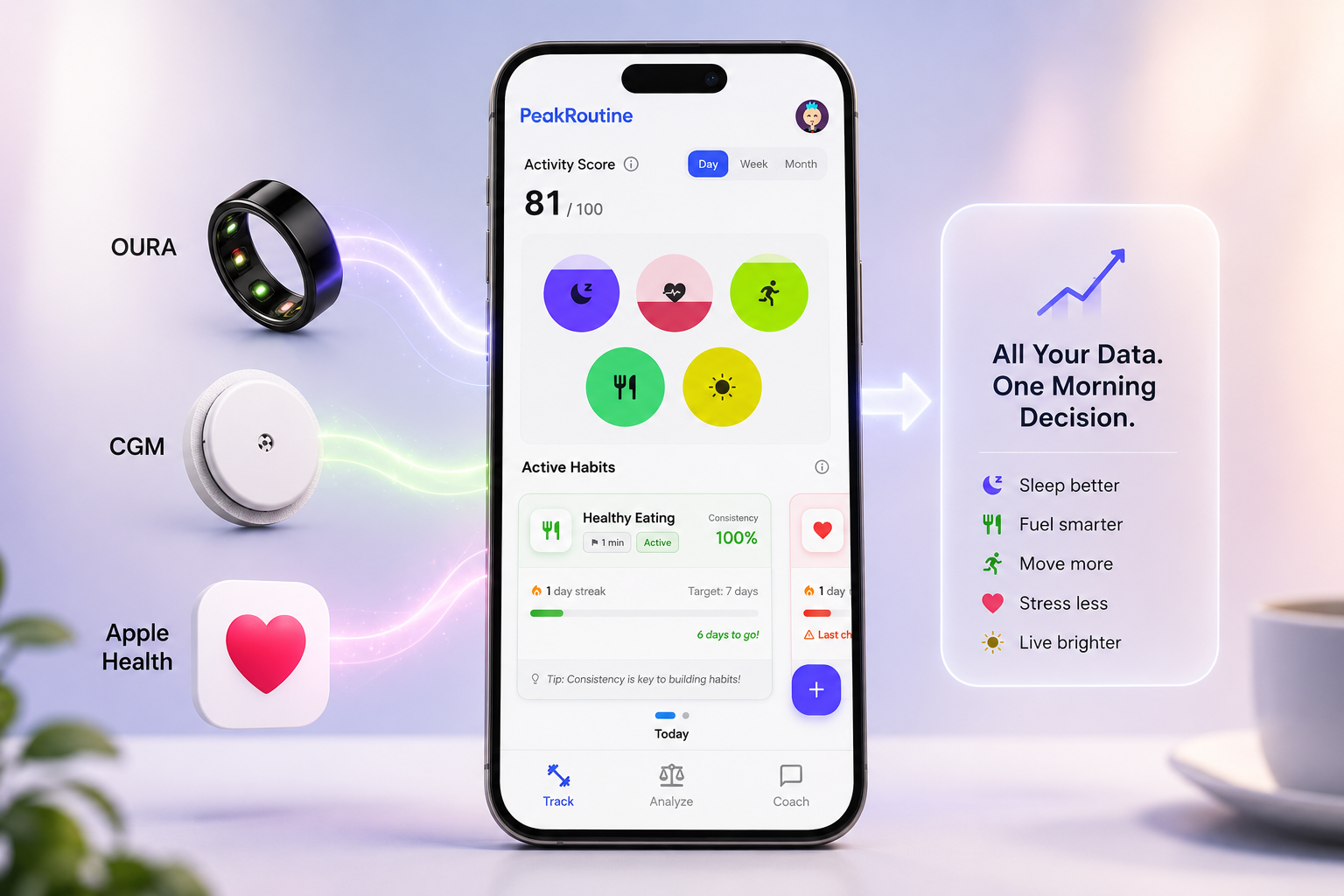
PeakRoutine is built for exactly this — correlating biomarkers from blood panels with HRV, RHR, and recovery trends from whichever wearable you use, to surface the connections that live in the gap between your lab portal and your ring app.
And once you've ruled a cause like this in or out, the day-to-day question returns: what should today actually look like? That's the job of a recovery routine that adapts each morning.
FAQ
Can a wearable detect low iron directly?
No. No current consumer wearable measures ferritin or iron levels directly. What wearables track are the downstream effects on heart rate variability and resting heart rate — both of which are affected by iron deficiency through autonomic and cardiovascular mechanisms.
What ferritin level should I aim for as a performance baseline?
This is a clinical question. Standard lab reference ranges mark deficiency below 12–15 ng/mL. Many practitioners working in performance medicine consider levels below 30–50 ng/mL to be functionally suboptimal, particularly for people with high training loads. Discuss optimal targets with your doctor in the context of your symptoms and data.
How long does it take HRV to recover after ferritin is addressed?
Based on how long it takes ferritin stores to replenish — typically 2–3 months of supplementation under clinical guidance — expect 8–12 weeks before seeing a meaningful shift in your HRV baseline. Individual response varies, and the pace of recovery is also influenced by the severity of depletion and dietary iron intake.
References
- Association of iron status and B-vitamin markers with heart rate variability on 24-hour Holter monitoring (n = 213 adults). 2026. https://pubmed.ncbi.nlm.nih.gov/41923733/